Delaney Manufacturing Services
For many inventors and established manufacturers alike, the transition from a successful prototype to full-scale production is often referred to as the “valley of death.”
It is the stage where technical feasibility has been proven, but the financial and operational hurdles of mass manufacturing loom large. Traditional manufacturing models often demand significant upfront capital for tooling, high minimum order quantities (MOQs), and complex logistics across multiple vendors.
However, scaling your product does not have to result in crippling overhead. By adopting a strategic approach to
injection molding prototyping and leveraging a unified manufacturing partner, businesses can bridge the gap from a “napkin sketch” to a high-volume retail product with minimal financial friction.
The Traditional Scaling Challenge: Why Overhead Usually Spikes
The primary driver of high overhead in plastic manufacturing is fragmentation. In a typical scenario, a company might hire an independent CAD designer, contract a separate tool shop for mold production, and then source a third party for the actual molding. This fragmented supply chain leads to:
- Expensive Tooling Errors: If the mold maker and the injection molder are not in sync, design flaws can lead to costly mold modifications or complete re-fabrication.
- High Minimum Order Quantities: Many large-scale manufacturers refuse to run machines for anything less than 10,000 units, forcing smaller companies to tie up capital in excess inventory.
- Logistics Inflation: Shipping parts from a molder to an assembly house and then to a fulfillment center adds significant cost and time to every unit.
To scale efficiently, you must eliminate these silos.
Delaney Manufacturing Services solves this by housing the entire product lifecycle under one roof, ensuring that every design decision is made with the final production run in mind.
Phase 1: Prototyping with the End in Mind (Design for Manufacturability)
The first step in scaling without overhead is
Design for Manufacturability (DFM). Prototyping is not just about making a single part that works; it is about designing a part that can be manufactured efficiently 100,000 times.

Using
CAD design services early in the process allows engineers to optimize wall thickness, draft angles, and gate placements. While
3D printing is an excellent tool for rapid visual validation, it does not always mimic the mechanical properties of injection-molded plastic.
By integrating DFM at the prototyping stage, you avoid the “redesign tax” that occurs when a prototype works in a 3D printer but fails in a high-pressure injection mold. This foresight is critical for maintaining a low-cost transition into manufacturing.
Phase 2: Bridging the Gap with Short-Run Injection Molding
Once the design is validated via 3D printing, the next logical step is often
short run injection molding. This is where many companies stumble, as they assume they must immediately invest in high-cost, multi-cavity hardened steel molds.
Strategic scaling utilizes “bridge tooling” or soft tooling, often made from high-grade aluminum. Aluminum molds are significantly cheaper and faster to produce than steel, yet they allow for the production of hundreds or even thousands of parts using the actual production-grade resin.
The “No Minimums” Advantage
One of the most effective ways to reduce overhead is to avoid the trap of MOQs. At Delaney Manufacturing, we maintain a
no minimums policy. This allows our clients to:
- Test the market with a pilot run of 500 units.
- Fulfill early orders without holding massive inventory.
- Gather real-world user feedback before committing to high volume injection molding tooling.
This incremental approach ensures that your capital is spent on growth rather than storage fees and unsold stock.
Phase 3: Transitioning to High-Volume Production
When market demand is proven, the transition to
high volume injection molding becomes a matter of efficiency and automation rather than a risky gamble.

At this stage, the investment shifts toward multi-cavity, hardened steel molds designed for millions of cycles. Because the part was already optimized during the short-run phase, the risk of tool failure or part defects is virtually eliminated.
The goal here is to drive down the
piece-part price. High-volume production benefits from faster cycle times and automated material handling, which offsets the initial cost of the steel mold over time. By staying with the same partner who handled the prototyping, the historical data from previous runs is used to fine-tune the high-volume process immediately.
The “Under One Roof” Advantage: Cutting Hidden Costs
The most significant reduction in overhead comes from consolidating the supply chain. When you work with a full-service partner, you eliminate the hidden costs of project management and logistics.
- Mold Production & Management: Handling existing molds or creating new ones in-house ensures that the tooling is always maintained for peak performance.
- Metal-to-Plastic Conversion: Many manufacturers save up to 50% in production costs by re-engineering complex metal components into durable, high-performance plastic parts.
- Full-Service Fulfillment: Scaling isn’t just about making the part; it’s about getting it to the customer.

In-house assembly, sonic welding, and custom retail packaging mean your product is ready for the shelf the moment it leaves the injection molding machine. Direct drop-shipping to distributors further slashes the overhead associated with secondary warehousing.
Strategies for Reducing Total Cost of Ownership (TCO)
To truly scale without overhead, manufacturers must look beyond the price-per-part and consider the
Total Cost of Ownership. This includes:
- Material Selection: Choosing the right thermoplastic can reduce cycle times and cooling requirements, lowering the overall energy cost per part.
- Tooling Life Cycle: Investing in a slightly better mold material early on can prevent thousands of dollars in maintenance costs later.
- Speed to Market: A same-day response from your manufacturing partner can be the difference between hitting a retail window and missing a season of sales.
A Partner in Growth
Scaling from a prototype to a global product is a complex journey, but it does not require a massive corporate infrastructure. By focusing on design optimization, utilizing short-run production to bridge the gap, and consolidating your manufacturing and fulfillment with a single expert partner, you can maintain a lean operation while competing at a high level.
With over
50 years of experience, Delaney Manufacturing Services specializes in guiding innovators through every stage of this process. Whether you are an entrepreneur with a new concept or an established manufacturer looking for a more reliable partner, our end-to-end capabilities are designed to help you scale efficiently.
Ready to take your project from prototype to production? Contact us today for a consultation and see how our “under one roof” approach can reduce your manufacturing overhead.
|
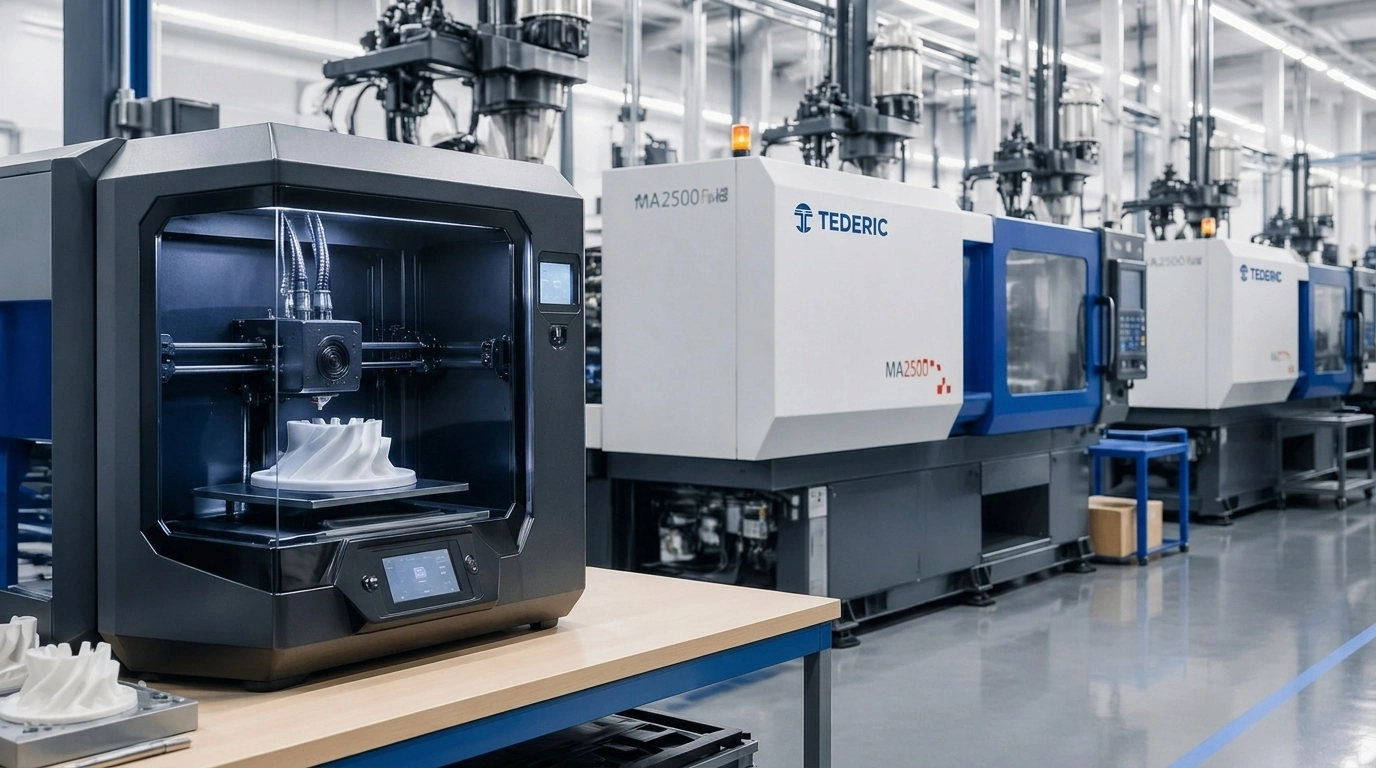
| Images for illustrative purposes. |