Selecting the right process is a balance of your current budget, your projected sales volume, your required lead time, and the performance expectations of the final part.
A 3D print farm and injection molding are not competing tools in every situation. In many successful product launches, they are used at different stages of the same program. 3D printing supports design validation, functional testing, pilot runs, and bridge production. Injection molding supports repeatable quality, lower unit cost at scale, and production-ready cosmetic finishes.
A 3D print farm is often the fastest path from CAD to physical part. Because there is no steel tooling required, design changes can be made digitally and new parts can be produced in hours rather than weeks.
This approach is especially useful for:
A print farm also reduces risk during development. Instead of discovering a design issue after a mold is cut, engineers can inspect and test multiple printed revisions before moving forward. That makes the product development cycle more efficient and protects tooling investment.
Injection molding requires a larger upfront commitment, but it becomes significantly more efficient as volume increases. Once the mold is built and validated, the process can produce parts with excellent repeatability, fast cycle times, and consistent material properties.
Injection molding is typically the right choice when you need:
For companies preparing for retail distribution, OEM supply, or long-term production, injection molding usually provides the strongest balance of cost control, quality, and scalability.
The practical decision often comes down to this:
That distinction matters because a process that is ideal for ten parts may be completely wrong for ten thousand. A printed part can be the correct answer during testing, early sales, or bridge fulfillment. The same part may later need to transition to molding once demand stabilizes and volume justifies tooling.
| Feature | 3D Print Farm | Injection Molding |
|---|---|---|
| Tooling Cost | $0 | $3,000 – $50,000+ |
| Setup Time | Hours | Weeks to Months |
| Unit Cost | High | Very Low |
| Design Flexibility | High (Digital) | Low (Fixed in Steel) |
| Best For | Prototyping & Bridge Production | Scaling & High Volume |
| Material Strength | Good (Anisotropic) | Excellent (Isotropic) |
Appearance is one of the clearest differences between these manufacturing methods, and it directly affects how a product is perceived by customers, investors, and internal stakeholders.
Most 3D printed parts show visible signs of the additive process, especially when compared with molded production parts. Common visual characteristics include:
These characteristics do not make printed parts unusable. In fact, they are often completely acceptable for engineering samples, fit checks, pilot runs, and bridge production. However, they usually signal that a part is still in a prototype or pre-production stage.
Injection molded parts generally present a more refined, production-ready appearance. Typical characteristics include:
This finish advantage is one reason injection molding is often selected when aesthetics are important. If the part will be customer-facing, packaged for retail, or integrated into a branded product, appearance can be just as important as structural performance.


Surface appearance affects more than looks. It can influence:
For example, a printed part may be ideal for verifying fit inside an assembly, but it may not accurately represent the final consumer-facing appearance. An injection molded part, by contrast, provides a more reliable preview of the finish, texture, and quality level that production customers will receive.
For many companies, the best path is not choosing one process forever. It is using each process where it creates the most value.
A common progression looks like this:
This strategy reduces development risk, protects cash flow, and creates a smoother path to market.
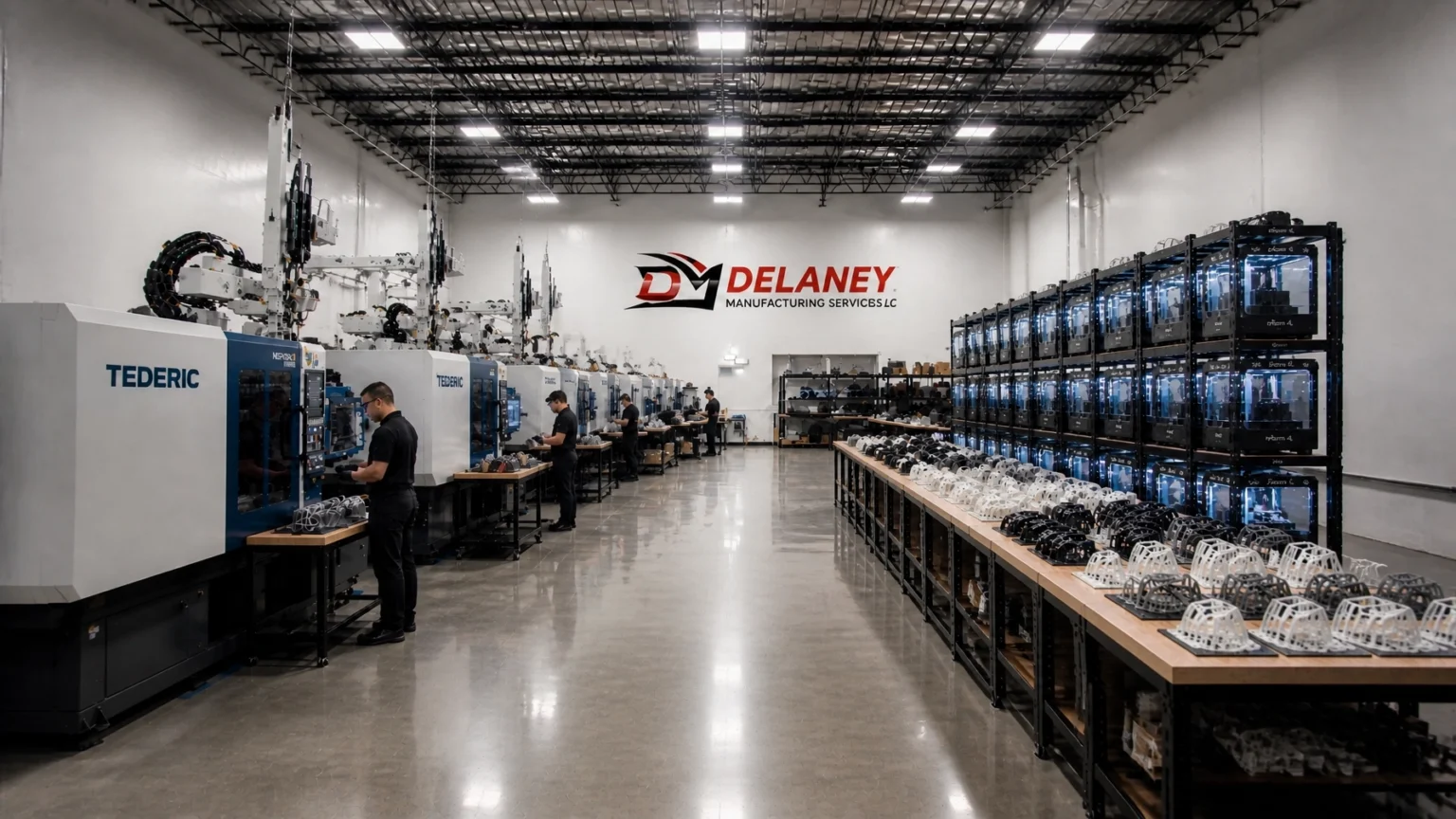
At Delaney Manufacturing Services, we specialize in the entire product lifecycle. We do not just provide a service; we provide a roadmap. We can take you from a napkin sketch to a retail-ready product, utilizing our in-house 3D print farm for your initial launch and our fleet of Tederic injection molding machines when it is time to scale.
Whether you need a dozen parts or a hundred thousand, our team is ready to help you navigate the complexities of manufacturing to ensure your project is a success.
| Images for illustrative purposes. |