
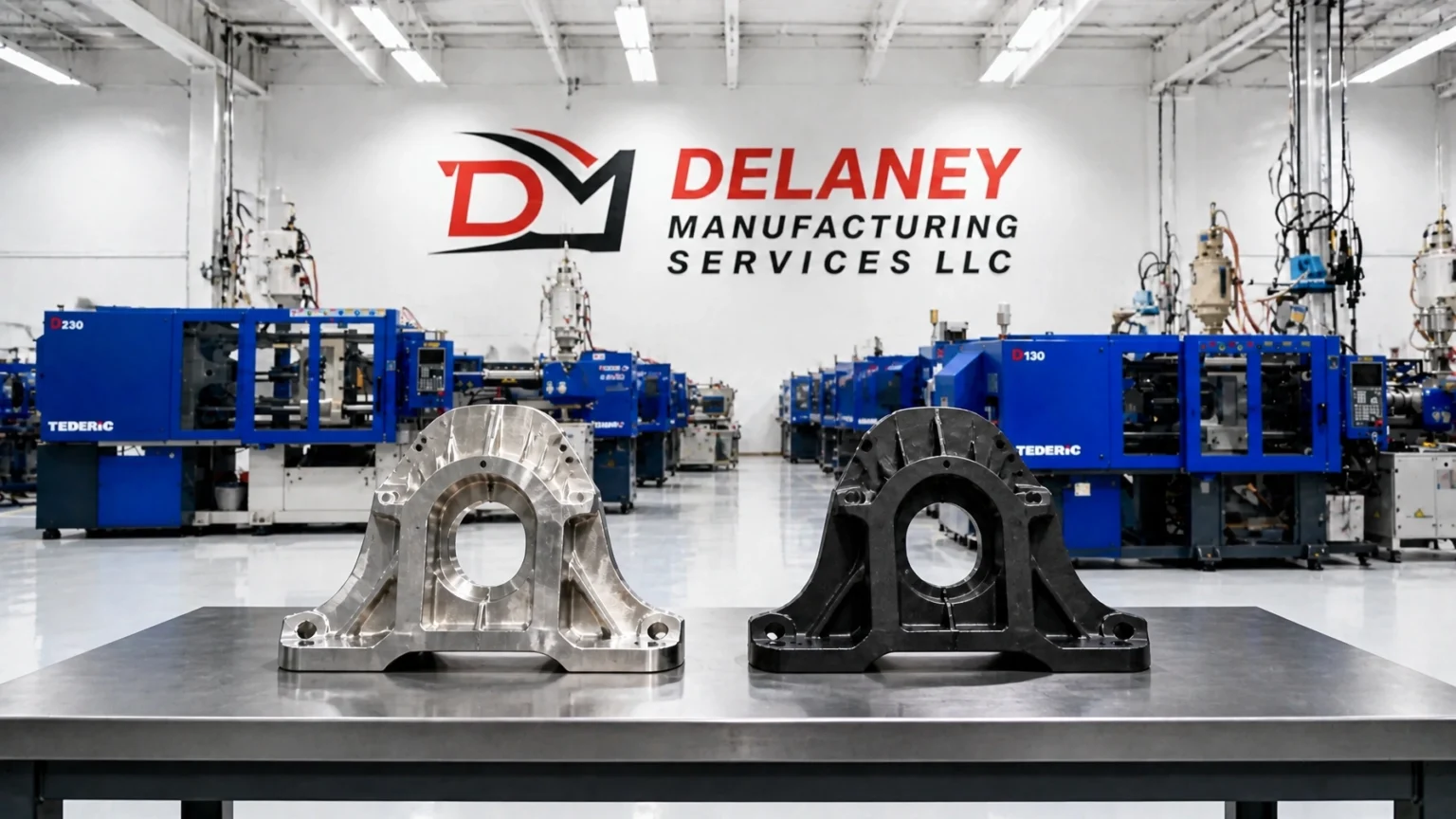
For decades, the default choice for heavy-duty industrial components has been metal. Steel, aluminum, and various alloys were the only materials perceived to possess the structural integrity and environmental resilience required for high-stress applications. However, significant advancements in material science and precision engineering have challenged this status quo.
Today, high-performance engineered plastics are increasingly replacing metal components across the automotive, aerospace, medical, and industrial sectors. At Delaney Manufacturing Services, we specialize in Metal-to-Plastic Conversion, helping clients re-engineer their parts to achieve superior performance at a significantly lower cost.
This article examines the technical and economic trade-offs between metal and plastic to help you determine which material is best suited for your heavy-duty parts.
Metal has historically been favored for its high tensile strength, stiffness, and ability to withstand extreme thermal conditions. For parts that must operate in environments exceeding 400°F or those that require the absolute highest levels of rigidity, metal remains a critical choice.
However, traditional metal fabrication: incorporating machining, welding, deburring, and coating: is often a labor-intensive and expensive process. As production volumes increase, the per-unit cost of metal parts remains relatively high due to these secondary operations and the volatility of raw material prices.
Modern engineering resins are not the “generic” plastics used in consumer goods. These materials are often reinforced with glass fibers, carbon fibers, or mineral fillers to achieve mechanical properties that rival those of cast aluminum and some steels.
When a part is designed specifically for injection molding, it can often meet or exceed the performance specifications of its metal predecessor. This transition is not a simple material swap; it requires a comprehensive re-engineering of the part’s geometry to leverage the unique strengths of polymers.

One of the most compelling reasons for conversion is the economic impact. While the initial tooling for a high-quality injection mold is an investment, the per-part cost is significantly lower than metal fabrication.
Plastics are generally 50% to 70% lighter than their metal counterparts. In industries where weight directly impacts operational costs: such as transportation or handheld equipment: this reduction is revolutionary.
Injection molding allows for intricate geometries that would be impossible or prohibitively expensive to machine in metal.

Many metals require expensive coatings or platings to survive harsh environments. In contrast, many engineering resins are inherently resistant to moisture, chemicals, and UV radiation.
| Feature | Metal Fabrication | Injection Molded Plastic |
|---|---|---|
| Material Cost | Volatile and often high | Relatively stable and lower per unit volume |
| Production Speed | Slow (machining/welding) | Rapid (seconds per cycle) |
| Weight | High | Low (50-70% lighter) |
| Corrosion Resistance | Requires coating/plating | Inherently high in most resins |
| Design Complexity | Limited by machining tools | High (undercuts, ribs, bosses) |
| Secondary Operations | Frequent (painting, deburring) | Minimal to none |
Successful conversion requires more than just choosing a resin. Our team at Delaney Manufacturing Services follows a rigorous process to ensure that your re-engineered part performs reliably under heavy-duty stress.

While the benefits of plastic are extensive, it is not a universal solution. Metal remains the superior choice for:
Transitioning from metal to plastic is a strategic business decision that offers competitive advantages in cost, weight, and design innovation. By partnering with an experienced manufacturer like Delaney Manufacturing Services, you can navigate the technical complexities of this transition with confidence.
Whether you are looking to revitalize an existing product line or are in the early stages of Product Development, we provide the expertise to take your concept from a “napkin sketch” to a retail-ready, high-performance product.
From Short-Run Production to high-volume manufacturing, our facility is equipped to handle the entire product lifecycle under one roof. We specialize in complex re-engineering, in-house assembly, and full-service fulfillment to ensure your heavy-duty parts meet the highest industry standards.
Ready to see if your metal parts are candidates for plastic conversion? Contact us today for a same-day response and a technical evaluation of your project.
| Images for illustrative purposes. |