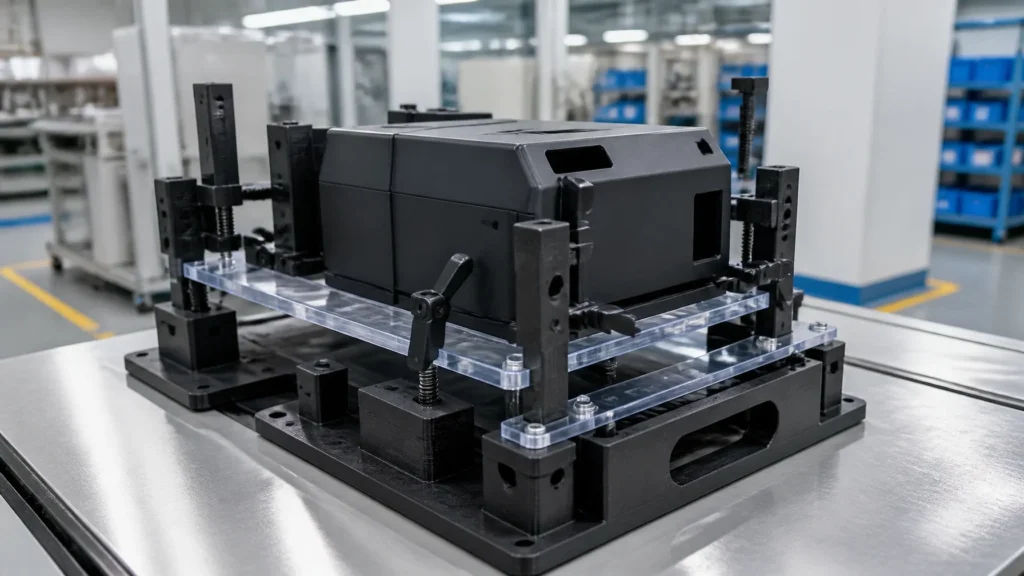
In high-volume manufacturing, the difference between a profitable production run and a logistics nightmare often comes down to seconds. On an assembly line, those seconds are won or lost in the “hand-offs”: the moments when a technician picks up a part, aligns it, and secures it for the next operation. While generic clamps, vices, and modular kits are often the first tools manufacturers reach for, they frequently become the primary source of bottlenecks and quality variances.
At Delaney Manufacturing Services, we have observed that the most successful product launches utilize
custom assembly jigs and fixtures designed specifically for the unique geometry of the component. By leveraging in-house
3D printing and
laser cutting technology, we create bespoke tooling that ensures precision, eliminates human error, and drastically accelerates the fulfillment process.
The Precision Gap: Custom vs. Off-the-Shelf Solutions
The primary lure of off-the-shelf (OTS) workholding is immediacy. It is tempting to believe that a standard modular fixture or a universal vice can handle the job with minimal setup. However, OTS solutions are designed for “general use,” which in manufacturing is often a synonym for “compromise.”
1. Repeatability and Tolerance Control
An off-the-shelf fixture requires the operator to manually align the part every time. This introduces a variable: the operator’s judgment. Even the most skilled technician cannot achieve 100% repeatability across an 8-hour shift when using generic tools. Custom jigs, however, are engineered to provide a
positive lock on the part. When a part can only fit into a jig in one specific orientation, the tolerance stack-up is minimized, and repeatability becomes a mathematical certainty rather than a human effort.
2. Setup Time and Operator Fatigue
Generic tools often require multiple adjustments: tightening screws, aligning stops, or shimming gaps. These micro-actions add up. A custom-designed assembly nest allows for “drop-in” positioning. By reducing the number of manual adjustments, we not only speed up the cycle time but also reduce the ergonomic strain on the assembly team, leading to higher morale and fewer fatigue-related errors.
Error-Proofing Through Design (Poka-Yoke)
One of the most critical advantages of custom tooling is the implementation of
Poka-Yoke, or mistake-proofing. In an ideal assembly environment, it should be physically impossible to assemble a product incorrectly.

By integrating specific features into a jig: such as pins that only align with certain holes or asymmetrical nests that only accept a part in the correct orientation: we “design out” the possibility of failure. This is particularly vital in complex assemblies where components may look similar but are not interchangeable. Custom jigs ensure that every clip, screw, and adhesive application happens in the exact intended location, every single time.
The Role of In-House 3D Printing and Laser Fabrication
Traditionally, the cost and lead time of custom metal jigs were prohibitive for many projects. Waiting six weeks for a CNC-machined steel fixture could derail a product launch. At Delaney, we have bypassed this barrier by integrating
additive manufacturing and
laser cutting directly into our tooling workflow.
Rapid Prototyping for Tooling
Using our
3D printer workstation, we can design, print, and test an assembly jig in less than 24 hours. This allows us to iterate on the tool design alongside the product design. If a client makes a late-stage change to a part’s CAD file, we can update the jig and have a new version ready for the assembly floor by the next morning.

Laser-Cut Precision
While 3D printing is excellent for complex, organic shapes, our laser capabilities provide the speed and rigidity needed for flat templates and structural jig bases. Laser-cutting acrylic or specialized polymers allows us to create high-contrast templates that guide technicians during bonding or marking processes.
 Key benefits of in-house jig fabrication include:
- Cost Reduction: 3D printed jigs can be 90% cheaper than traditional machined alternatives.
- Lightweight Ergonomics: Polymer-based jigs are easier for staff to move and position, reducing the risk of workplace injury.
- Complex Geometry: We can create “conformal” jigs that perfectly match the curved surfaces of an injection-molded enclosure: something nearly impossible with standard off-the-shelf hardware.
End-to-End Integration: From CAD to Final Assembly
The true power of custom jigs is realized when they are considered at the start of the
product development phase. At Delaney Manufacturing Services, we don’t just look at the part; we look at the process.

Our engineers use the final CAD models of your product to design the “inverse” geometry for the assembly fixtures. This integrated approach means that by the time the first
injection-molded parts come off the press, the assembly team already has the custom nests and jigs they need to begin
fulfillment and shipping. This end-to-end synergy is what allows us to offer rapid turnaround times and maintain strict quality control.
The Economic Reality: Calculating the ROI of Custom Tooling
Many entrepreneurs and manufacturers hesitate at the “upfront cost” of custom tooling. However, the ROI is found in the reduction of “hidden costs”:
- Scrap and Rework: A single misaligned component can ruin an entire assembly. If a custom jig prevents just 2% of your production from becoming scrap, the tool often pays for itself within the first week.
- Labor Efficiency: If a custom fixture saves 10 seconds per unit on a 10,000-unit run, you have saved nearly 28 hours of labor costs.
- Market Speed: Using in-house 3D printed jigs allows you to start shipping weeks earlier than if you waited for traditional metal tooling.
Summary: A Strategic Investment in Quality
In the competitive world of product manufacturing, “good enough” is rarely sufficient. Off-the-shelf jigs are useful for general workshop tasks, but they lack the precision, error-proofing, and ergonomic benefits required for professional-grade assembly.
By choosing custom, in-house fabricated jigs, you are investing in the long-term reliability of your product and the efficiency of your supply chain. At Delaney Manufacturing Services, we take pride in our ability to take a concept from a napkin sketch to a retail-ready product, supported by the precision of our custom-built manufacturing aids.
Ready to optimize your assembly process?
Whether you need high-volume production or a short-run prototype, our team is ready to design the custom solutions your project deserves. Contact us today for a
same-day response on your next project.
|
| Images for illustrative purposes. |