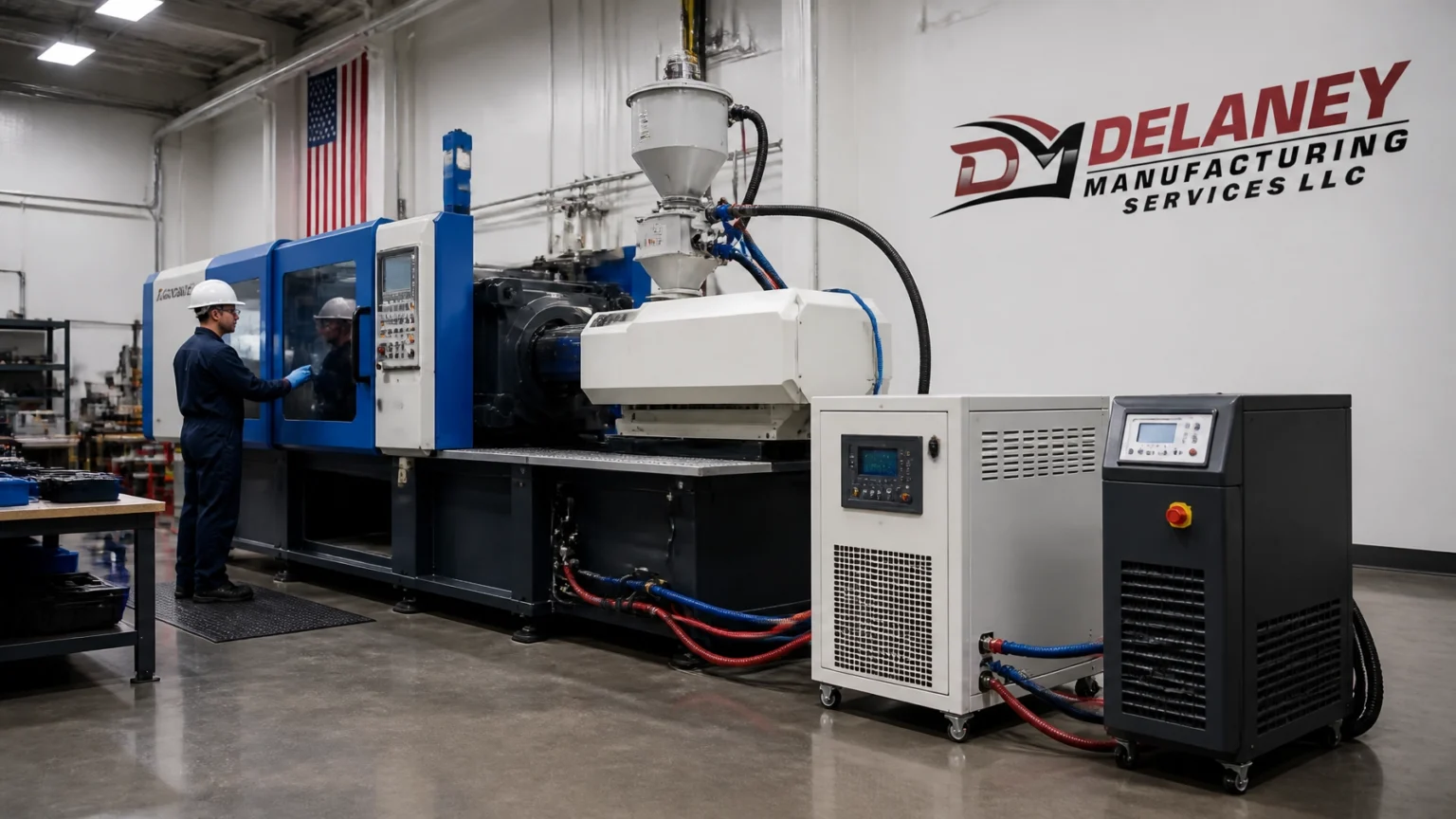
In plastic injection molding, mold temperature is a critical process variable: not a minor machine setting. The temperature of the mold surface affects how the polymer flows, fills, packs, cools, shrinks, and ultimately performs as a finished part.
A mold that is too cold can create incomplete filling, visible flow defects, and excessive internal stress. A mold that is too hot can increase cycle time, accelerate shrinkage, and create dimensional instability. Uneven temperature across the mold can produce warpage and inconsistent results even when the average setpoint appears correct.
Effective
mold temperature control requires more than connecting a water line and selecting a number on a controller. It requires the right equipment, balanced cooling circuits, reliable sensors, adequate flow, and process validation. At Delaney Manufacturing Services, we use
process chillers and Thermolator temperature-control units to maintain the precise conditions required for each resin, mold, and part design.
How Mold Temperature Influences the Injection Molding Process
During each molding cycle, hot polymer enters the mold cavity under pressure. The mold must remove heat at a controlled rate so the part solidifies sufficiently for ejection without sacrificing quality.
Mold temperature influences several stages of the process:
- Flow: A warmer mold surface keeps the polymer fluid for longer, helping it travel through thin walls, ribs, corners, and complex geometry.
- Filling: The correct temperature can reduce premature freezing and support complete cavity filling.
- Packing: Stable temperature allows the machine to transfer packing pressure consistently while the material remains responsive.
- Cooling: Mold temperature determines how quickly heat moves out of the part and how long the part must remain in the mold.
- Shrinkage: Cooling conditions affect how much the polymer contracts as it transitions from molten material to a solid part.
- Warpage: Temperature differences from one region of the mold to another can cause uneven shrinkage and distortion.
- Weld lines: A controlled mold temperature can improve the appearance and strength of weld lines where separate flow fronts meet.
- Surface finish: The mold surface must remain warm enough for the polymer to replicate its texture, gloss, and detail accurately.
Cooling often represents the largest portion of the total molding cycle. For that reason, controlling temperature precisely can improve both part quality and production efficiency.

Chillers and Thermolators: Different Tools for Temperature Control
Chillers and Thermolators both support mold temperature control, but they perform different functions.
What a Process Chiller Does
A
process chiller removes heat from circulating water or another cooling fluid. It provides a controlled cooling source for mold circuits and other temperature-sensitive equipment. Unlike facility air-conditioning systems, a process chiller is designed to respond to industrial heat loads and maintain process-specific temperatures.
In injection molding, the chiller:
- Removes heat carried back from the mold.
- Lowers the temperature of the process fluid.
- Sends the controlled fluid back through the mold cooling channels.
- Responds to changing heat loads during production.
The chiller is especially valuable when production generates more heat than a simple supply-water system can remove or when the mold requires a stable temperature below the facility’s normal water-loop temperature.
What a Thermolator Does
A
Thermolator is a mold temperature-control unit that heats and circulates water or another suitable fluid through the mold. It maintains a precise mold-temperature setpoint by combining:
- A circulation pump
- A heater
- Cooling controls
- Temperature sensors
- Pressure and flow monitoring
- Automated control logic
A Thermolator does not simply make the mold hot. It continuously manages the balance between heat added to the mold and heat removed from it. If the mold is below the selected setpoint, the heater raises the fluid temperature. If the mold becomes too warm, the unit allows cooling flow to remove excess heat.
How the Systems Work Together
The chiller and Thermolator can operate as complementary parts of one temperature-control strategy. The chiller supplies a reliable source of cooled process fluid and removes heat from the return loop. The Thermolator circulates fluid through the mold and fine-tunes the temperature using heating and cooling controls.
This arrangement helps maintain a stable temperature during production rather than allowing the mold to drift warmer with every shot. The exact configuration depends on the resin, the mold design, the target temperature, and the required process window. Not every mold requires the same equipment or operating method.
The Correct Setpoint Depends on the Entire Application
There is no universal injection molding temperature that works for every part. The correct setpoint depends on the interaction between the material, mold, machine, and part design.
Important considerations include:
- Resin type: Amorphous materials and semi-crystalline materials respond differently to cooling. Materials such as nylon, POM, PBT, and polypropylene may require carefully controlled mold temperatures to achieve the desired crystallinity and mechanical performance.
- Mold material: Steel and aluminum transfer heat at different rates. The mold material affects how quickly heat moves from the cavity surface into the cooling channels.
- Wall thickness: Thick sections retain heat longer and may require additional cooling time or specialized cooling circuits. Thin walls may freeze quickly and require a warmer mold to maintain flow.
- Part geometry: Ribs, bosses, deep pockets, inserts, and uneven wall sections can create local hot spots that require targeted cooling.
- Surface requirements: Glossy, textured, polished, and appearance-critical surfaces may require different temperature conditions to reproduce the mold finish consistently.
- Production requirements: A prototype or short run may prioritize development flexibility, while high-volume production may require a tighter process window and optimized cycle time.
Material supplier recommendations provide a starting point. The final setpoint should be established through trials, inspection, and process validation.
Problems Caused by Incorrect Mold Temperature
Temperature problems can appear as cosmetic defects, dimensional failures, mechanical weakness, or lost production capacity.
| Mold condition |
Common consequences |
| Too low |
Short shots, premature freezing, visible flow lines, weak weld lines, poor surface replication, higher residual stress |
| Too high |
Longer cooling cycles, excessive shrinkage, sticking or difficult ejection, dimensional drift, material degradation in some applications |
| Uneven |
Warpage, sink marks, gloss variation, inconsistent dimensions, localized stress, unpredictable cycle time |
A colder mold is not automatically better. Lower temperatures can reduce cooling time, but they may also prevent the polymer from filling the cavity correctly. A warmer mold can improve flow and surface finish, but the added cooling time may reduce throughput.
The goal is not simply to remove heat as quickly as possible. The goal is to remove heat
uniformly and repeatably.
Balanced Cooling Requires More Than a Temperature Setpoint
A controller can display the correct number while the mold still contains hot and cold zones. Effective cooling depends on how the temperature-control system connects to the mold and how the mold’s cooling channels are designed.
Delaney evaluates factors such as:
- Cooling-channel layout: Channels should be positioned to remove heat evenly from the cavity and core.
- Circuit balance: Multiple circuits may be needed when different mold regions have different heat loads.
- Flow rate: Insufficient flow limits heat transfer and can create localized temperature rise.
- Supply and return temperatures: Comparing inlet and outlet temperatures helps identify whether a circuit is removing heat effectively.
- Sensors: Temperature sensors provide feedback to the controller and help operators identify drift.
- Flow monitoring: Flow meters and alarms can reveal restrictions, blocked channels, leaks, or poor connections.
- Mold condition: Scale, corrosion, and debris inside cooling channels can reduce performance over time.
Where appropriate, operators may also verify actual mold or cavity-surface temperature instead of relying only on the temperature shown at the Thermolator or chiller. The fluid setpoint and the steel temperature are related, but they are not always identical.

A Practical Example: Improving Repeatability and Reducing Scrap
Consider a hypothetical multi-cavity mold producing a thin-walled housing. At startup, the mold-temperature controller is set correctly, but one cooling circuit has restricted flow. The mold reaches the target temperature on average, yet one side remains warmer than the other.
The first parts may show:
- Slight dimensional differences between cavities
- Gloss variation across the cosmetic surface
- A mild warp near a thicker boss
- Inconsistent fit during assembly
If the operator adjusts injection pressure to compensate, the issue may appear to improve temporarily. However, the underlying temperature imbalance remains. As production continues, the mold warms further and the parts drift outside the acceptable dimensional range.
A validated correction would address the temperature system directly:
- Inspect and restore flow through the restricted circuit.
- Confirm supply and return temperatures.
- Verify the Thermolator setpoint and sensor response.
- Allow the mold to reach thermal equilibrium.
- Run a controlled series of shots.
- Measure critical dimensions and inspect surface quality.
- Lock the validated settings into the production process.
For illustration, a run that previously produced 160 unacceptable parts out of 2,000 may produce only 40 unacceptable parts after the cooling imbalance is corrected. That represents a reduction in scrap from 8% to 2%. The figures are an example, but the principle is practical: stable temperature reduces process drift and makes every subsequent shot more predictable.
Why Temperature Validation Matters to Purchasing and Engineering Teams
For product developers and purchasing teams, mold temperature control should be considered during the quoting and tooling stages: not after defects appear in production.
A capable molding partner should be prepared to discuss:
- The resin’s recommended mold-temperature range
- The mold’s cooling-channel configuration
- The expected cycle-time impact
- How temperature and flow will be monitored
- Which dimensions and cosmetic features require validation
- How process settings will be documented for repeat production
These details connect engineering decisions to business outcomes. Stable temperature can reduce scrap, rework, inspection interruptions, and delivery risk while supporting consistent part performance.
Delaney Manufacturing Services Controls the Complete Process
Delaney Manufacturing Services brings more than
50 years of plastic manufacturing experience to projects ranging from one-part development work to high-volume production. Our team uses process chillers and Thermolator units to manage mold temperature according to the requirements of the material, tool, and finished part.
We can support the full product lifecycle, including:
- CAD design and product development
- 3D printing and prototyping
- Mold production and mold management
- Short-run and high-volume injection molding
- Metal-to-plastic conversion
- In-house assembly and packaging
- Direct drop-shipping and fulfillment
There are
no minimums, and our team makes every effort to provide a
same-business-day response. Whether you have an existing mold, a new product concept, or a precision plastic component requiring a reliable production partner,
contact Delaney Manufacturing Services to discuss your requirements.
Learn more about our
injection molding process,
plastic materials, and
new product development services.
|
| Images for illustrative purposes. |