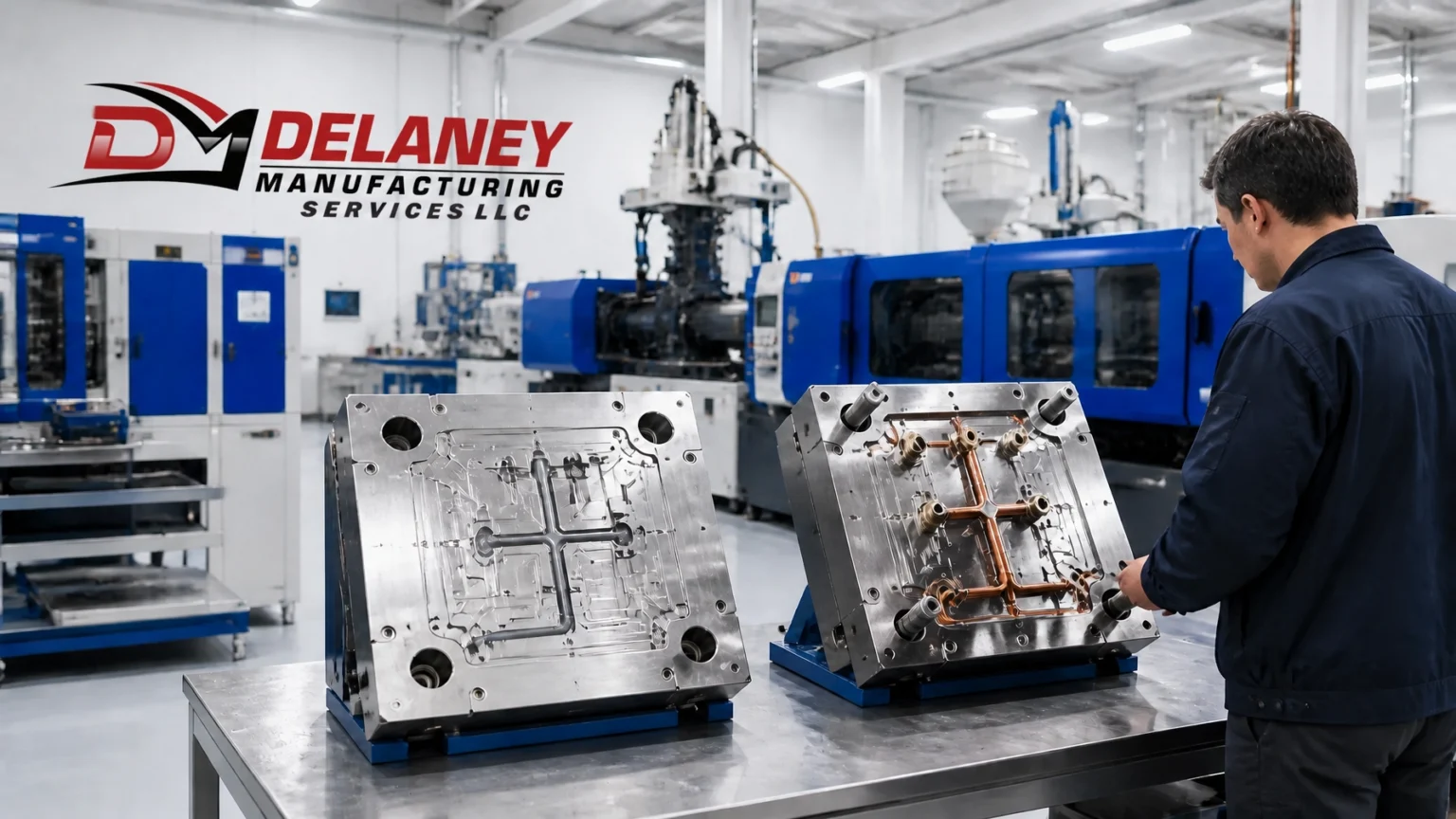
Selecting the right runner system is an important decision in
plastic injection molding. The runner controls how molten resin travels from the injection molding machine nozzle into the mold cavities. Its design affects material usage, cycle time, tooling cost, maintenance, part quality, and production flexibility.
The two primary options are
cold runner molds and
hot runner molds. Neither system is automatically better for every project. The right choice depends on the part design, resin, expected production volume, quality requirements, color-change frequency, and total cost over the life of the program.
What Is a Cold Runner Mold?
A cold runner mold uses unheated channels machined into the mold plates. The plastic flows through these channels, fills the cavities, and then cools along with the molded parts.
A typical cold-runner system includes:
- Sprue: The primary passage that receives molten resin from the machine nozzle.
- Runners: Branching channels that distribute resin from the sprue to one or more cavities.
- Gates: Smaller openings that direct resin from the runner into each cavity.
- Mold cavities: The spaces that form the finished parts.
After injection and cooling, the parts and the solidified runner system are ejected. The runner and sprue must then be separated from the parts. Depending on the application, that material may be reground, discarded, or used in another approved process.

Advantages of Cold Runner Systems
Cold runner molds remain widely used because they are straightforward, flexible, and economical to build.
Lower initial tooling cost: A cold runner mold does not require a heated manifold, hot drops, electrical connections, or a dedicated temperature-control system within the mold. This generally makes the mold less expensive to manufacture.
Simpler construction: With fewer specialized components, cold runner molds are typically easier to inspect, modify, repair, and maintain.
Broad material compatibility: Cold runner systems can be suitable for many thermoplastics, including materials that may be sensitive to prolonged heat exposure. Resin selection still requires careful review of processing temperatures and residence time.
Fast color and material changes: The runner system cools and ejects with every cycle. This means less material remains inside the mold when changing from one color or resin to another.
Good fit for variable production: Cold runners are often practical for prototypes, pilot runs, short production campaigns, and projects with uncertain future demand.
Tradeoffs of Cold Runner Systems
The primary disadvantage is that the runner becomes part of the shot weight but not part of the saleable product.
Cold runner molds can result in:
- More material waste when the runner-to-part ratio is high.
- Additional labor or automation to separate runners from molded parts.
- Longer cycles when the runner requires additional cooling before ejection.
- Regrind handling requirements, including grinding, storage, identification, and controlled blending.
- Potential gate vestiges that must be evaluated against the part’s appearance and functional requirements.
A well-designed cold runner can reduce these disadvantages. Runner layout, runner diameter, gate location, cavity balance, and part size all affect material efficiency and cycle time.
What Is a Hot Runner Mold?
A hot runner mold uses a heated manifold and heated nozzles to keep the resin molten as it travels from the machine nozzle to the mold cavities. The manifold distributes the material to individual hot drops or nozzles, which feed the gates.
Common hot runner components include:
- Heated manifold: Distributes molten resin to multiple cavities.
- Heated nozzles: Maintain the resin temperature as it approaches each gate.
- Temperature sensors and heaters: Monitor and regulate individual zones.
- Valve gates: Mechanically open and close the gate using a valve pin for precise flow control.
- Gate inserts or tips: Control the final entry point into each cavity.
Because the resin remains molten inside the runner system, the runner does not normally eject as a solid part of every shot. With a properly designed valve-gated system, the process can produce very little runner-related scrap.

Advantages of Hot Runner Systems
Reduced material waste: The runner remains inside the heated system instead of being ejected and discarded each cycle. This can be particularly valuable when molding expensive engineering resins or small parts with relatively large cold runners.
Potentially shorter cycle times: The process does not require a solid runner to cool before ejection. When runner cooling is the limiting factor, a hot runner can improve production output.
Improved cavity balance: A well-designed manifold can deliver resin more consistently to each cavity. Balanced filling supports repeatable part weights, dimensions, and appearance.
Greater control over filling: Valve gates can control when and where resin enters the cavity. This can help manage weld lines, flow fronts, gate timing, and cosmetic requirements.
Reduced secondary handling: Parts may eject without an attached runner, reducing the need for trimming, degating, or automated runner separation.
Hot runners are not a guarantee of better parts. Mold design, cooling, venting, processing conditions, resin preparation, and machine setup remain equally important.
Tradeoffs of Hot Runner Systems
The additional components that make hot runners efficient also increase their complexity.
Higher tooling cost: The mold must accommodate the manifold, heaters, thermocouples, nozzles, insulation, wiring, and control hardware.
More specialized maintenance: Hot runner systems require attention to heaters, sensors, valve pins, seals, manifolds, and temperature zones. A failure in one component can interrupt production.
Longer color-change procedures: The manifold retains molten resin between cycles. Changing from a dark color to a light color, or from one resin to another, may require purging a significant volume of material.
Thermal sensitivity: Some resins may degrade if exposed to excessive temperature or residence time. Processing recommendations from the resin supplier must be followed carefully.
More complex troubleshooting: Flow imbalance, leakage, heater failure, gate wear, and temperature variation may require specialized knowledge or support from the hot runner supplier.
Cold Runner vs. Hot Runner: Key Differences
| Consideration |
Cold Runner Mold |
Hot Runner Mold |
| Initial tooling cost |
Generally lower |
Generally higher |
| Material waste |
Produces a solid sprue and runner each cycle |
Little or no runner scrap during steady-state production |
| Cycle time |
May include runner cooling time |
Can eliminate runner cooling as a limitation |
| Part quality |
Can produce excellent parts with proper design |
Offers added control for balanced filling and valve gating |
| Maintenance |
Simpler and typically less specialized |
More components and specialized service requirements |
| Color changes |
Usually faster and easier |
Can require extended purging |
| Short-run production |
Often practical |
May not recover its additional tooling cost |
| High-volume production |
May carry higher variable costs |
Often attractive when volumes and demand are stable |
| Regrind |
Runner scrap may be reground when approved |
Primarily limited to startup, purge, and rejected-part material |
Regrinding Cold Runner Scrap
Regrinding can improve the economics of a cold runner mold, but it should not be treated as an automatic solution to runner waste.
Before reusing runner material, manufacturers should evaluate:
- Resin type and processing history
- Contamination from other materials or colors
- Moisture exposure
- Thermal degradation
- Regrind particle size and consistency
- Required mechanical and cosmetic performance
- Customer, regulatory, or industry-specific requirements
Some parts can tolerate a controlled percentage of regrind blended with virgin resin. Others require virgin material or impose strict limits on recycled content. Regrind should be clearly identified, stored separately, and introduced at a documented ratio.
A runner that can technically be reground may still create costs for labor, grinding equipment, storage, quality control, and material tracking. Those costs belong in the total comparison between cold and hot runner systems.

When Is a Cold Runner the Practical Choice?
A cold runner mold is often the better choice when:
- The project has low or moderate production volume.
- The product is in the prototype, pilot, or market-validation stage.
- The expected product life is short or uncertain.
- The tooling budget is limited.
- The production schedule requires frequent color or resin changes.
- The resin is relatively low cost and runner scrap can be managed.
- The mold must remain simple to maintain or modify.
- The part design does not require complex valve-gate control.
Cold runners can also be practical when the mold will produce a wide range of parts or when future design changes are likely.
When Can a Hot Runner Provide Better Long-Term Economics?
A hot runner may provide better total economics when:
- Production volumes are high and stable.
- The tool will run for years or produce millions of parts.
- The resin is expensive or the cold runner would be large relative to the part.
- Cycle time has a significant effect on machine-hour cost.
- The part requires multiple cavities with carefully balanced filling.
- The application has demanding cosmetic or dimensional requirements.
- Automated production and minimal secondary handling are priorities.
- Regrind is restricted or undesirable for the application.
The correct analysis should compare the higher upfront cost of the hot runner with projected savings in resin, labor, cycle time, energy, and scrap. A hot runner that is ideal for a long-running production program may be unnecessary for a short-run product.
Questions to Ask Before Selecting a Runner System
Manufacturers should address the following questions during mold design and quoting:
- What is the expected annual volume and total lifetime volume?
- How long will the product remain in production?
- What resin will be used, and how costly is it?
- What is the runner-to-part ratio for the proposed mold layout?
- How often will colors or materials change?
- Are there restrictions on regrind or recycled content?
- What cosmetic requirements apply to the gate location and vestige?
- What dimensional tolerances and cavity-to-cavity consistency are required?
- Will the mold require future design changes or additional cavities?
- What maintenance resources and hot runner support are available?
- Can automation remove, separate, or grind cold runner scrap efficiently?
- Which system produces the lowest total cost over the planned production life?
The answer is rarely found by comparing tooling quotes alone. A lower mold price may result in higher material and labor costs over time. A higher hot runner investment may be justified when it produces measurable savings across a large production program.
Delaney Manufacturing Services Can Help Evaluate the Full Picture
Runner-system selection should be part of a broader
custom injection molding and mold-design review. Delaney Manufacturing Services evaluates the part geometry, resin, mold layout, production volume, quality requirements, and long-term economics before recommending a path forward.
With
more than 50 years of experience, Delaney supports projects from early
product development and CAD design through prototyping,
mold production and management, production molding, and fulfillment. Our team works with both existing molds and new tooling, supports short runs and high-volume programs, and has
no minimum order quantity.
Our end-to-end capabilities include in-house assembly, packaging, and direct fulfillment. We also make every effort to provide a
same-business-day response to project inquiries.
For help evaluating a cold runner mold, hot runner mold, or complete plastic injection molding program,
submit your project to Delaney Manufacturing Services.
|
| Images for illustrative purposes. |