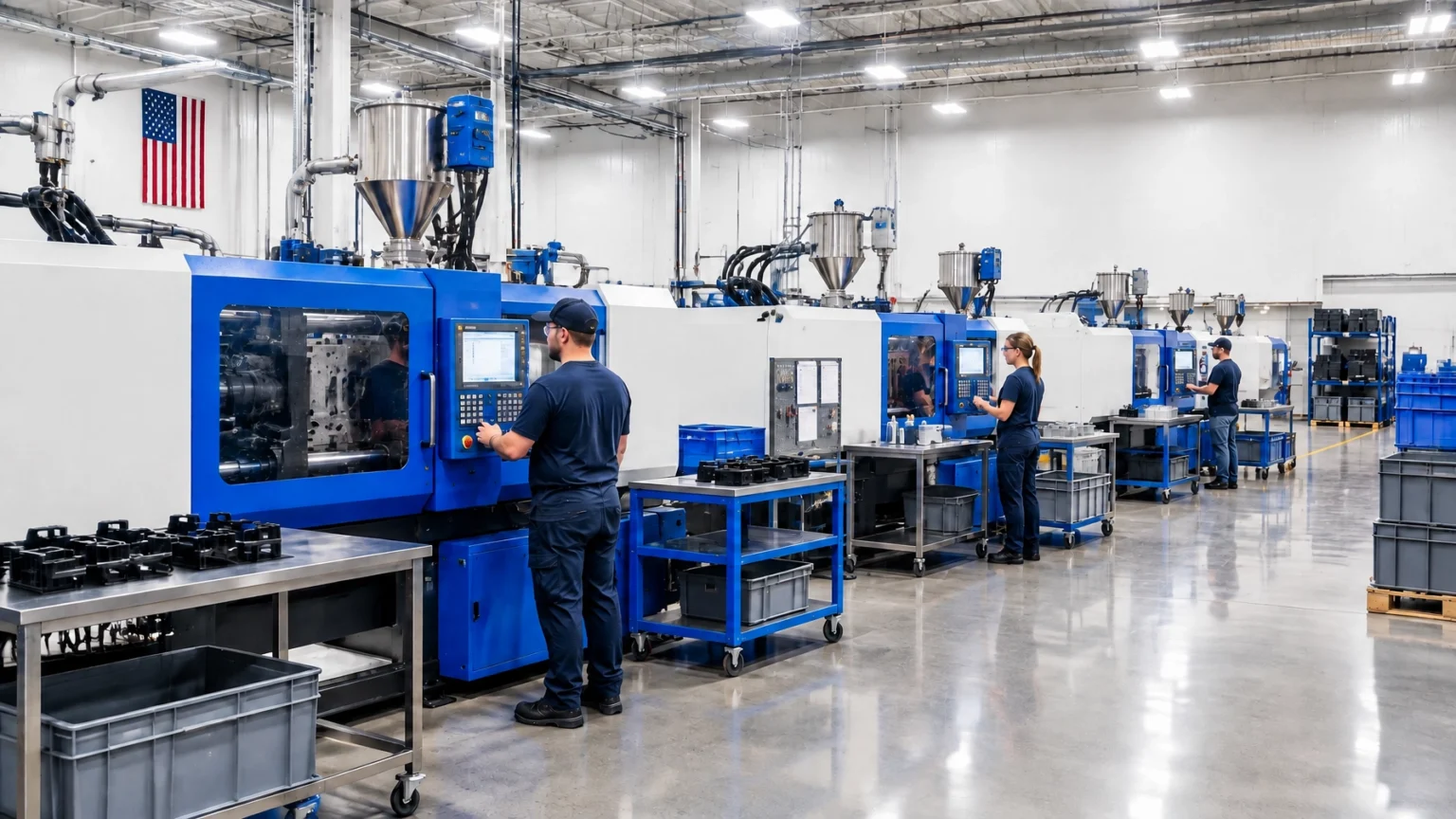
Launching a plastic product requires more than choosing a resin and producing parts. The production model you select affects your tooling investment, launch schedule, per-part cost, inventory exposure, and ability to respond to market feedback.
The central decision is often between
short run injection molding and
high volume injection molding. Neither option is universally better. The right choice depends on your expected demand, design maturity, budget, launch timing, and long-term production plan.
For many new products, the most practical strategy is to begin with a short run and transition to high volume injection molding after the design and market have been validated.
Short Run and High Volume Injection Molding Defined
Short run injection molding produces a limited quantity of production-quality parts. It is commonly used for prototypes, pilot programs, market testing, bridge production, and niche products. Depending on the part and project requirements, short runs may range from hundreds to several thousand parts.
High volume injection molding is designed for sustained production in quantities ranging from tens of thousands of parts to hundreds of thousands or millions. These projects typically use durable steel tooling, multi-cavity molds, automated handling, and production systems optimized for repeatability and throughput.
Both methods use the same fundamental plastic injection molding process:
- Plastic resin is heated until it becomes molten.
- The material is injected into a mold cavity under pressure.
- The part cools and solidifies.
- The mold opens and the finished part is ejected.
- The cycle repeats.
The key differences are in the tooling strategy, production economics, and level of scalability.
Short Run Injection Molding: Lower Risk and Greater Flexibility
Short run molding is often the best fit for a product that is still being refined. It allows a business to obtain real molded parts without immediately committing to the cost and complexity of a long-life, high-cavity production mold.

Tooling investment
Short-run tools are generally designed for lower initial investment. Aluminum, pre-hardened steel, or other suitable materials may be used depending on the part geometry, resin, expected quantity, and required tool life.
This approach can reduce the financial risk of an early launch. If customer feedback leads to a revised enclosure, mounting feature, wall thickness, or cosmetic detail, modifying a simpler tool is typically more manageable than changing a complex hardened-steel production mold.
Per-part cost
The per-part cost is usually higher than with high volume molding because the tooling expense is spread across fewer parts. However, the lowest unit price is not always the lowest total project cost.
Producing 1,000 parts at a higher unit cost may be more economical than producing 100,000 parts that do not sell. Short runs help limit:
- Excess inventory
- Obsolete parts after a design change
- Upfront capital exposure
- Storage and fulfillment costs
- Market risk before demand is proven
Lead time
Short-run tooling and production can often move from approved design to first parts in a matter of weeks. Exact timing depends on part complexity, material availability, mold requirements, and the supplier’s workload.
This compressed schedule can help inventors and entrepreneurs:
- Meet a planned launch date
- Supply samples to distributors or investors
- Test products with early customers
- Support a crowdfunding or pilot campaign
- Produce bridge inventory while permanent tooling is developed
Flexibility
Flexibility is the primary advantage of short run molding. A company can learn from actual use rather than relying entirely on assumptions made during the design phase.
Short-run parts can reveal issues involving:
- Fit and assembly
- Ergonomics
- Snap features and fasteners
- Cosmetic appearance
- Material performance
- Packaging requirements
- Installation or service procedures
This makes short run injection molding especially valuable when the design is functional but not yet fully frozen.
High Volume Injection Molding: Lower Unit Cost at Scale
High volume injection molding is the preferred model when demand is established and the product design is unlikely to change significantly.

Tooling investment
High volume programs usually justify hardened steel tooling with a longer service life. Multi-cavity molds can produce several parts with each machine cycle, substantially increasing output.
The upfront investment may include:
- Production-grade mold construction
- Multiple cavities
- Hot runner or specialized gating systems
- Automated part removal
- Inspection fixtures
- Secondary operations
- Process validation and documentation
This investment is appropriate when the tool will be used consistently over a long product life. It is less attractive when annual demand is uncertain or the design is still changing.
Per-part cost
Once the mold is paid for, high volume production generally provides a lower cost per part. The savings come from several factors:
- Tooling cost is distributed across many parts
- Multi-cavity molds increase output per cycle
- Long production runs reduce setup frequency
- Automation reduces labor per unit
- Purchasing efficiencies may reduce material costs
For established manufacturers competing on price or supplying a large distribution network, these advantages can have a significant effect on margins.
Lead time
High volume production typically requires more planning before the first production run. Hardened steel molds, multi-cavity designs, process development, sampling, inspection, and validation all add time.
A high volume program may require several months from final design approval to production readiness, depending on complexity and project scope. Starting the tooling process before demand is confirmed can create unnecessary schedule and financial pressure.
Quality control
High volume programs support formalized process controls and repeatable inspection systems. These may include documented setup parameters, first-article inspection, sampling plans, dimensional checks, and statistical process monitoring.
High volume molding is particularly appropriate when consistency is essential across a large customer base or when the component supports a regulated, safety-critical, or high-throughput application. However, short run parts can also be produced to production-quality standards. The appropriate inspection plan should be based on the part’s function, risk, and customer requirements rather than volume alone.
Side-by-Side Comparison
| Factor |
Short Run Injection Molding |
High Volume Injection Molding |
| Typical use |
Prototypes, pilot programs, market testing, bridge production, niche products |
Mature products, recurring orders, retail programs, high-demand components |
| Tooling |
Lower-cost aluminum or pre-hardened tooling may be suitable |
Hardened steel, multi-cavity, long-life production tooling |
| Upfront investment |
Lower to moderate |
Higher |
| Per-part cost |
Higher at low quantities |
Lower at sustained volume |
| Lead time |
Generally faster to first parts |
Longer tooling and validation cycle |
| Design flexibility |
High |
Lower after the tool is finalized |
| Inventory risk |
Lower |
Higher if demand is uncertain |
| Automation potential |
Scalable as requirements grow |
Often highly automated |
| Best fit |
Unproven designs or demand |
Validated designs and reliable forecasts |
How Tooling Strategy Affects Your Launch
Tooling should be evaluated as part of the entire product plan rather than as an isolated expense.
A short-run mold may be the better financial decision when:
- The product is entering the market for the first time.
- The design may change after customer testing.
- The first order is measured in hundreds or a few thousand parts.
- Demand forecasts are based on limited market data.
- You need to launch quickly.
- Cash flow is more important than achieving the lowest initial unit cost.
High volume tooling may be justified when:
- You have purchase orders or strong demand evidence.
- The product design has completed functional and assembly testing.
- The expected production quantity is substantial.
- The product has a stable, long-term market.
- Per-part cost is a major competitive factor.
- The mold will be used continuously enough to recover its investment.
A Practical Decision Framework
Use the following process to select the appropriate production model.
1. Establish your first-year quantity
Estimate realistic demand for the first six to twelve months. Separate confirmed orders from optimistic projections. A product with an expected demand of 1,000 units should not automatically be tooled like a product with confirmed demand of 100,000 units.
2. Assess design maturity
Ask whether the design has been tested for:
- Manufacturability
- Assembly
- Strength and durability
- Material compatibility
- User handling
- Packaging and shipping
If important changes remain possible, short-run tooling provides valuable flexibility.
3. Calculate total program cost
Do not compare unit prices alone. Include:
- Tooling
- Engineering
- Mold maintenance
- Material
- Labor
- Inspection
- Packaging
- Warehousing
- Freight
- Potential scrap or obsolete inventory
The correct solution minimizes total business risk while supporting the launch objective.
4. Consider a bridge strategy
Many businesses do not need to choose one model permanently. A bridge strategy can begin with short run injection molding while sales develop and higher-volume tooling is designed or built.
This approach can provide:
- Early production parts for launch.
- Market feedback before final tooling decisions.
- Revenue that helps fund the next production phase.
- A smoother transition to lower-cost, higher-output manufacturing.
5. Match quality requirements to the application
Define what must be inspected and how often. Functional dimensions, cosmetic surfaces, material properties, assembly fit, and labeling may all require different controls.
A capable manufacturing partner should help develop a quality plan that reflects the product’s actual requirements.
Moving From Prototype to Retail-Ready Product
Injection molding prototyping is most valuable when it connects directly to production planning. A prototype should not only demonstrate the concept. It should help answer whether the part can be manufactured reliably, assembled efficiently, packaged economically, and shipped without damage.

A complete product development process may include:
- CAD design and design-for-manufacturing review
- 3D printing and prototype evaluation
- Material selection
- Mold design and production
- Short-run or high-volume molding
- Secondary printing and finishing
- Assembly
- Packaging
- Inventory management
- Direct fulfillment and drop-shipping
This end-to-end coordination reduces handoffs and gives the manufacturer greater visibility into the complete product lifecycle.

Which Option Is Better for Your Product Launch?
For most first-time launches,
short run injection molding is the safer starting point. It reduces tooling exposure, accelerates market entry, and allows design improvements before a larger commitment.
For a validated product with stable demand,
high volume injection molding is usually more economical. The higher tooling investment can be justified by lower unit costs, faster cycle economics, and long-term production capacity.
The best answer may be a planned progression:
Concept → CAD design → prototype → short run → market validation → production tooling → high volume manufacturing → assembly and fulfillment
Delaney Manufacturing Services supports both short runs and high volume production with
no minimums, serving projects from a single part to millions of components. With more than 50 years of experience, Delaney can support product development, custom injection molding, existing mold management, new mold production, assembly, packaging, and fulfillment under one roof.
Explore Delaney’s new product development services,
learn about the injection molding process, or
submit your project for a customized quote. The team makes every effort to provide a personal response the same business day.
|
| Images for illustrative purposes. |