In the competitive landscape of modern manufacturing, the pressure to deliver high-quality components at lower costs is constant. For businesses navigating the complexities of
plastic injection molding, the answer to this challenge often lies in the strategic application of automation. At Delaney Manufacturing Services, we leverage over 50 years of industry experience, blending “old school wisdom” with cutting-edge robotics to optimize production.
Automation is no longer a luxury reserved for the world’s largest factories; it is a fundamental requirement for achieving the precision, speed, and cost-efficiency that our B2B clients demand. By integrating
sprue pickers and multi-axis robots into our molding cells, we provide a more reliable and economical manufacturing solution.
Understanding the Tools: Sprue Pickers vs. Multi-Axis Robots
To understand how automation drives down costs, it is essential to distinguish between the primary types of robotic systems used in the injection molding process.
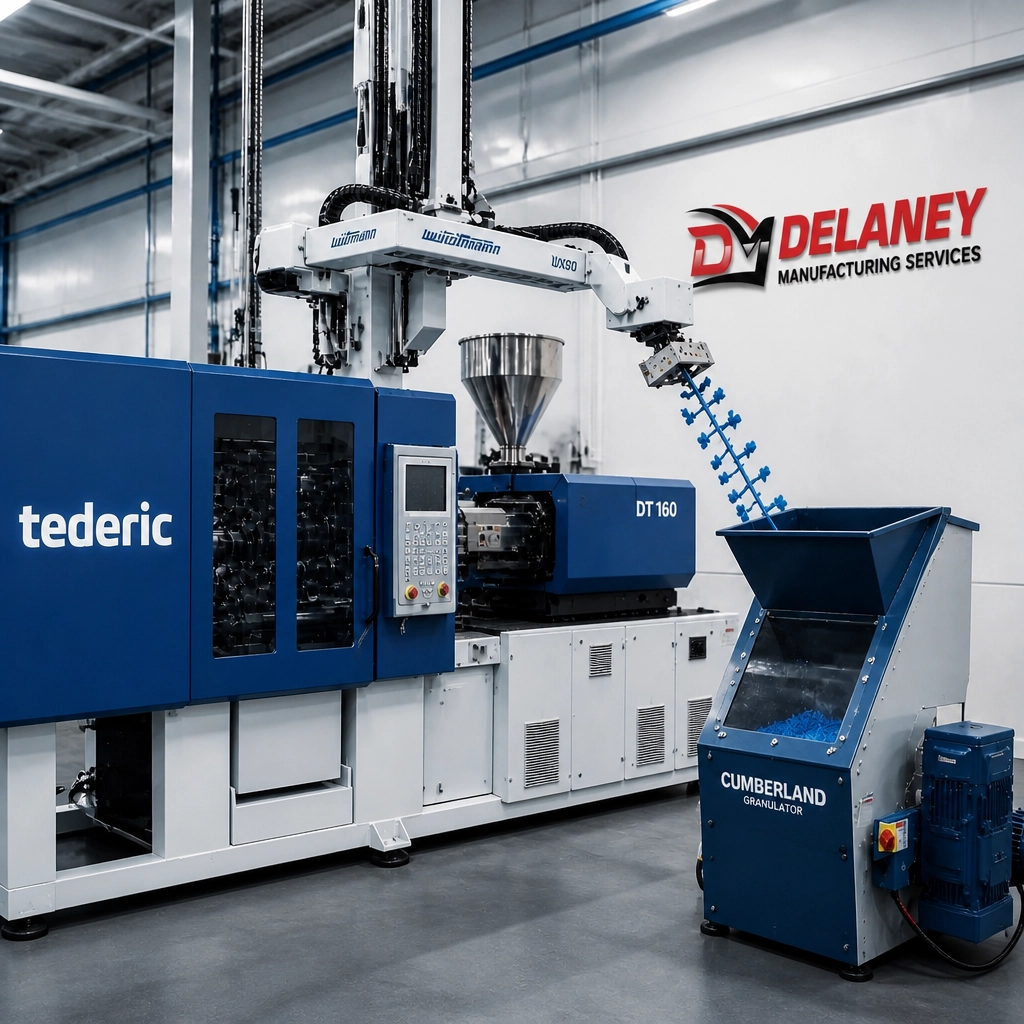
The Role of the Sprue Picker
A
sprue picker is a dedicated, high-speed robotic arm designed for a singular, critical task: removing the sprue and runner system from the mold. In
custom injection molding, specifically when using cold runner molds, the sprue (the channel through which plastic enters the mold) must be removed before the next cycle begins.
Manual removal is slow and introduces human error. A sprue picker, however, executes this task with sub-second precision, ensuring the mold is clear and ready for the next shot immediately. This turns a standard press into a semi-autonomous system that can run with minimal human intervention.
Advanced Multi-Axis Robots
For more complex operations, we utilize 3-axis robots. These machines go beyond simple removal. They can:
- Extract finished parts and place them precisely on conveyors.
- Perform secondary operations such as degating, trimming, or overmolding.
- Insert metal components into the mold for metal-to-plastic conversion projects.
- Stack parts for specialized packaging and fulfillment.

Direct Cost Savings: Why Automation Wins on the Bottom Line
The implementation of robotics at
Delaney Manufacturing Services directly translates into financial benefits for our customers. These savings are realized across several key operational areas.
1. Significant Reduction in Labor Costs
Manual part and sprue removal require constant operator presence at the machine. By automating these repetitive tasks, we drastically reduce the direct labor hours required per production run. This allows our skilled technicians to focus on higher-value activities, such as quality audits and process optimization, rather than manual handling. In
high volume injection molding, these labor savings scale exponentially, lowering the per-unit cost for the client.
2. Optimization of Cycle Times
In manufacturing, time is quite literally money. Every second shaved off a molding cycle increases the daily output of a machine. Sprue pickers can achieve take-out times as low as 0.7 to 1.2 seconds: speeds that a human operator cannot safely or consistently match. By maintaining a faster, more rigid cycle, we maximize the
Overall Equipment Effectiveness (OEE) and ensure your project is completed ahead of schedule.
3. Material Efficiency and Scrap Reduction
Automation ensures a clean, consistent separation between the molded part and the runner system. This precision prevents part deformation or cosmetic damage that often occurs during manual extraction. Furthermore, our automated systems can transfer sprues directly into beside-the-press granulators. This enables real-time recycling of material (regrind), reducing raw material waste and lowering the overall material cost for the project.
Quality Control and Shot-to-Shot Consistency
One of the most significant advantages of robotics is the elimination of variability. Human operators, while skilled, cannot perfectly replicate the same motion every 15 to 30 seconds for an eight-hour shift.
Robots provide
shot-to-shot consistency. Because the robot removes the part at the exact same millisecond every cycle, the mold temperature remains more stable, and the cooling process is perfectly uniform. This is vital for parts with tight tolerances where even a slight variation in cycle timing can lead to shrinkage or warping issues. When every part is identical, the rate of rejection drops, and the customer receives a more reliable product.

Protecting Your Investment: Mold Safety
A high-quality injection mold is a significant capital investment. One of the most common causes of mold damage is a “crashed” mold: when the press closes on a part or sprue that failed to drop or was improperly removed.
Robots and sprue pickers are equipped with sensors that verify the part has been successfully cleared before allowing the mold to close. This proactive protection prevents catastrophic damage to the parting lines and cavities, avoiding costly repairs and unplanned downtime. By utilizing automation, we extend the life of your tooling and ensure your production remains on track.
Scalability: From Short Run to High Volume
Whether you are an inventor with a new product concept or an established manufacturer requiring millions of units, automation provides the flexibility to scale.
- Short Run Molding: Even for smaller batches, the quick setup of modern sprue pickers allows us to maintain high quality without the need for large minimum orders.
- High Volume Production: For large-scale orders, a fully automated cell: incorporating part extraction, inspection, and automated packaging: ensures the lowest possible price point while maintaining rigorous quality standards.

The Delaney Manufacturing Advantage: Experience Meets Innovation
At Delaney Manufacturing Services, we understand that technology is only as effective as the experts who manage it. With over five decades of experience in the industry, we know how to identify exactly where automation will provide the most value for your specific project.
Our end-to-end services mean we don’t just “mold parts.” We handle the entire lifecycle:
- Product Development: Refining your CAD designs for automated manufacturing.
- Mold Production: Engineering tooling that is optimized for robotic extraction.
- Production: Utilizing the latest molding machines and robotic systems.
- Fulfillment: Direct drop-shipping to your customers from our in-house assembly and packaging department.
By choosing a partner that invests in automation, you are choosing a partner dedicated to your long-term success. We are committed to providing same-day responses and working with clients of all sizes to bring high-quality plastic components to the global marketplace.
If you are ready to see how our automated injection molding processes can reduce your costs and improve your product quality,
contact us today to discuss your project requirements.
|
| Images for illustrative purposes. |