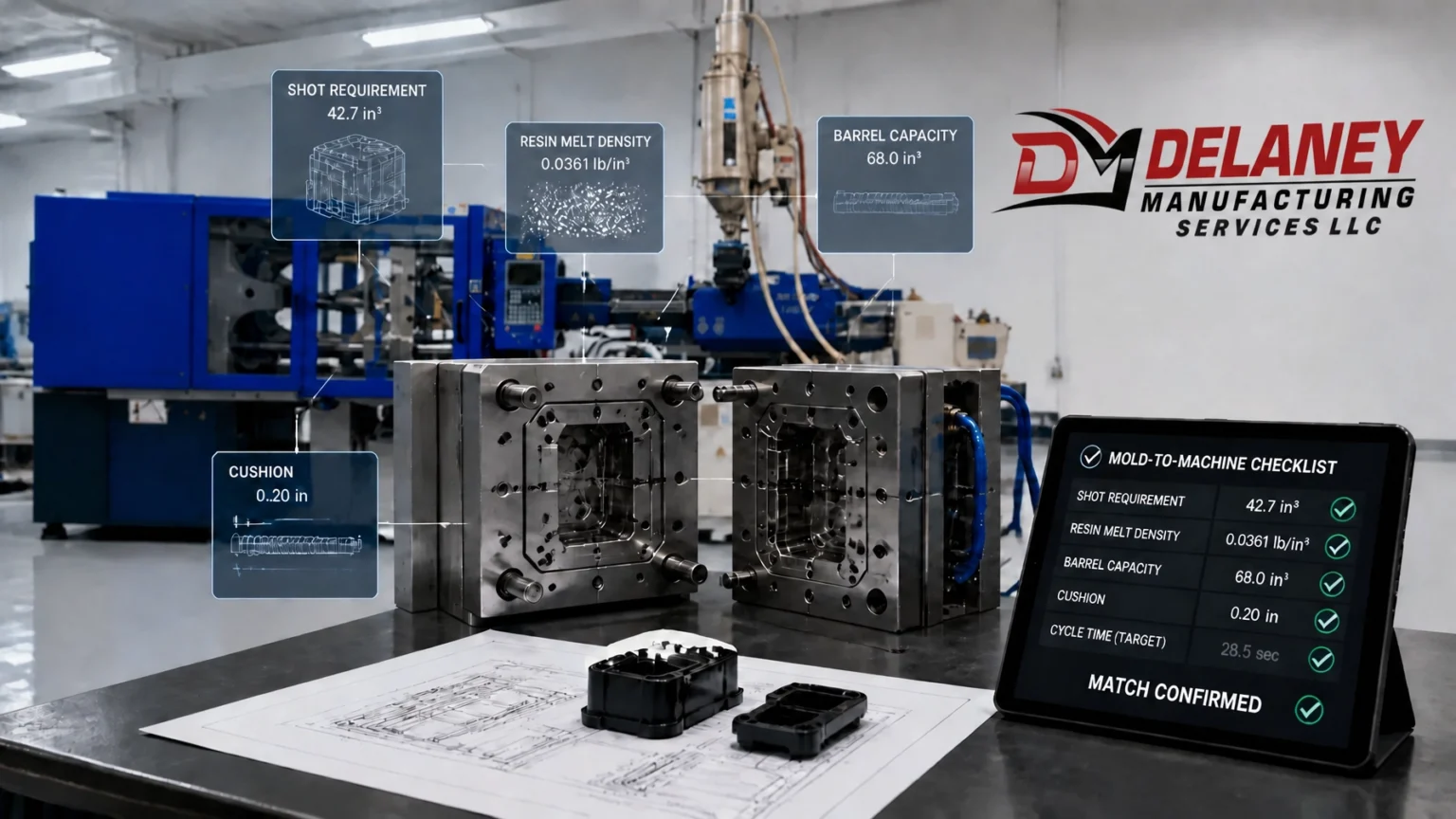
Selecting the correct injection molding machine involves more than matching a mold to available clamp force.
Shot size is equally important. The machine must be able to deliver enough molten resin to fill every cavity, runner, gate, and sprue while maintaining a stable cushion and an appropriate material residence time.
A machine with the wrong shot capacity can produce inconsistent parts, increase scrap, create processing problems, or expose the resin to excessive heat history. Proper
injection molding machine selection begins with calculating the mold’s total shot requirement and then matching that requirement to the machine’s barrel, screw, and material-handling capabilities.
What Shot Size Means in Injection Molding
Shot size refers to the amount of molten plastic that an injection molding machine can deliver during one injection cycle. Machine manufacturers commonly rate shot capacity by weight, often using general-purpose polystyrene as a reference material. Other specifications may list shot volume in cubic centimeters or cubic inches.
For a mold, the required shot includes more than the finished parts. It may also include:
- The molded parts
- Cold runners
- Gates
- The sprue
- Other material delivered into the mold during the cycle
A hot runner mold may eliminate most or all of the runner and sprue weight from the shot calculation. A cold runner mold requires those components to be included because that plastic is injected during every cycle.

How to Calculate Total Shot Weight
The basic calculation is:
Total shot weight = (part weight × number of cavities) + runner, gate, and sprue weight
For example, assume a four-cavity mold has the following specifications:
- Part weight: 18 grams
- Number of cavities: 4
- Cold runner and gate weight: 22 grams
The total shot weight is:
(18 g × 4) + 22 g = 94 g
That 94-gram result represents the material delivered to the mold during one cycle. It does not mean the machine should be selected with a 94-gram rated shot size and no additional consideration. The material, cushion, machine rating method, and process window must also be evaluated.
Account for Process Margin and Cushion
A machine must retain a controlled amount of material in front of the screw after injection. This remaining material is called the
cushion. Cushion helps maintain consistent packing pressure and provides a buffer against normal variation in the process.
Cushion is not simply another part of the mold’s plastic weight. It is material that remains in the barrel rather than entering the mold. However, the machine must have sufficient shot capacity and screw travel to deliver the required mold volume while maintaining that cushion.
For preliminary machine selection, engineers may apply a process margin to the calculated mold shot. A common approach is to evaluate the required shot with approximately
10% to 20% additional capacity, depending on the material, mold design, process requirements, and machine specifications.
The final selection should verify both:
- The mold’s total shot volume
- The physical screw position required to maintain a stable cushion
Convert Shot Weight to Shot Volume
Machine selection cannot rely on weight alone because different resins occupy different volumes when molten. The same 100-gram shot can require significantly different barrel capacity depending on the material’s melt density.
Use this formula:
Shot volume = total shot weight ÷ melt density
If the 94-gram shot in the example uses a resin with a melt density of 0.75 g/cm³:
94 g ÷ 0.75 g/cm³ = approximately 125.3 cm³
This volume should then be compared with the candidate machine’s usable shot capacity.
Melt density is different from solid density. It changes with resin type, temperature, formulation, fillers, and processing conditions. A material such as polypropylene may require a different screw stroke than a higher-density engineering resin for the same shot weight.
Material considerations may include:
- Polypropylene and polyethylene: Often have lower melt densities and may require greater volume for the same weight.
- ABS and polystyrene: Common machine-rating references may use polystyrene as a baseline.
- Glass-filled engineering resins: May require specialized screw and barrel considerations in addition to shot-capacity calculations.
- Heat-sensitive materials: Require careful residence-time control to prevent degradation.
Always use the resin supplier’s processing data when available. If a machine is rated in grams of general-purpose polystyrene, convert that rating appropriately before comparing it with another resin.
Choose an Appropriate Barrel Utilization Range
The mold should run within an appropriate portion of the machine barrel’s rated shot-capacity range. A practical starting point is approximately
25% to 65% of rated shot capacity, with the preferred operating point often toward the middle of that range.
The exact target depends on the machine, screw design, resin, cycle time, and application. The objective is to avoid both extremes:
- A shot that is too small for the barrel
- A shot that consumes nearly all available capacity
A machine with a larger rated shot does not automatically provide a better process. The usable window must account for the actual material and the screw’s ability to plasticize it consistently.
Risks of Using a Barrel That Is Too Large
A barrel that is substantially oversized for the mold can create excessive
material residence time. Residence time is the period resin remains inside the heated barrel before being injected.
When the shot uses only a small portion of the barrel, several problems may occur:
- Resin remains in the barrel for too long.
- Heat-sensitive material may discolor or degrade.
- The melt may experience excessive thermal history.
- Additives, colorants, or flame retardants may lose performance.
- The screw may not plasticize and mix the material as consistently.
- Startup and shutdown purging requirements may increase.
These problems are especially important for materials with narrow processing windows. A barrel that is too large may appear to provide plenty of capacity, but it can reduce part quality and process stability.
Risks of Using a Barrel That Is Too Small
An undersized barrel creates a different set of problems. If the required shot approaches the machine’s maximum capacity, the screw may not have enough travel to maintain a reliable cushion.
Potential consequences include:
- Short shots or incomplete filling
- Insufficient packing and holding pressure
- Part-to-part weight variation
- Dimensional instability
- Greater sensitivity to small changes in material or temperature
- Reduced ability to compensate for process variation
- Increased risk of running at the machine’s limits
A barrel that is too small can also require excessive screw recovery activity between cycles. The machine may struggle to recover the next shot within the available cooling time, which can extend the cycle or create inconsistent melt preparation.

Cushion and Screw Recovery Must Be Verified
Cushion is the controlled amount of molten material remaining in front of the screw at the end of injection and packing. A stable cushion helps the machine transfer pressure consistently from one cycle to the next.
The correct cushion depends on the machine, screw diameter, mold, resin, and process. The goal is not to maximize cushion. The goal is to maintain enough cushion for repeatable packing without using excessive barrel capacity.
Screw recovery is the process of melting and metering the next shot. The selected screw must be able to recover the required volume within the cycle time.
If screw recovery takes longer than the mold’s cooling or handling time, the machine may become the cycle-time constraint. If recovery occurs too quickly with excessive shear or heat input, the resin may be exposed to unnecessary thermal stress.
Machine selection should therefore review:
- Required shot volume
- Screw diameter
- Available screw stroke
- Recovery time
- Screw speed and back pressure
- Resin processing temperature
- Target cycle time
- Required cushion
Residence Time Affects Melt Consistency
Residence time is closely connected to shot size. A rough estimate can be developed by comparing barrel capacity with shot volume and multiplying by cycle time:
Estimated residence time = (barrel capacity ÷ shot volume) × cycle time
This estimate must be adjusted for the resin and the way the machine manufacturer defines barrel capacity. It should be treated as an engineering check rather than a substitute for machine trials.
The acceptable residence-time range varies by material. A stable commodity resin may tolerate a longer residence time than a heat-sensitive engineering resin. Material technical data should establish the appropriate limit.
The correct shot size improves melt consistency by keeping the resin in the barrel for an appropriate amount of time. This supports:
- More uniform melting
- More consistent color and additive distribution
- Stable viscosity
- Repeatable fill behavior
- More predictable packing and shrinkage
Why Correct Shot Size Improves Part Quality
A properly matched machine and mold create a more stable process window. When the barrel capacity, screw, resin, and mold shot are correctly aligned, the machine can deliver the required material without operating at either extreme.
Benefits include:
- Improved melt consistency: The resin receives appropriate heat and mixing.
- Better cycle stability: Screw recovery and injection can be completed predictably.
- More consistent part weight: Cushion and packing conditions remain repeatable.
- Improved dimensional control: Stable pressure and melt temperature reduce variation.
- Lower scrap rates: The process is less likely to produce short shots, flash, discoloration, or warpage.
- Improved material efficiency: The machine avoids unnecessary residence time and excessive purging.
Shot size must be considered together with clamp force, mold dimensions, tie-bar spacing, injection pressure, injection rate, screw design, and auxiliary equipment. No single machine specification determines whether a mold is a good match.
Practical Machine-Matching Guidance from Delaney Manufacturing Services
At Delaney Manufacturing Services, we evaluate the mold and the complete process rather than selecting equipment based on clamp tonnage alone. Our team has more than
50 years of plastic injection molding and machine-selection experience.
For a new project or an existing mold, we can review:
- Part weight and cavity count
- Cold runner, gate, and sprue weight
- Hot runner configuration
- Resin type, grade, melt density, and filler content
- Required shot volume and process margin
- Machine barrel and screw capacity
- Cushion and screw recovery requirements
- Expected residence time
- Cycle-time targets
- Mold dimensions, clamp requirements, and ejection needs
This evaluation is part of our end-to-end approach to
custom injection molding. Delaney can support projects ranging from early product development and mold management to short-run production, high-volume manufacturing, assembly, packaging, and fulfillment. We work with inventors, entrepreneurs, established manufacturers, and global customers, with no minimum project size.
When you need assistance matching a mold to the right machine, provide the part weight, cavity count, runner information, resin grade, target cycle, and mold documentation. Our team is committed to same-day responses whenever possible and can help determine whether an existing mold is suited to a particular machine or whether another production strategy would be more effective.
Explore Delaney’s
plastic injection molding services, review our
manufacturing process, or
contact Delaney Manufacturing Services to discuss your project.
|
| Images for illustrative purposes. |