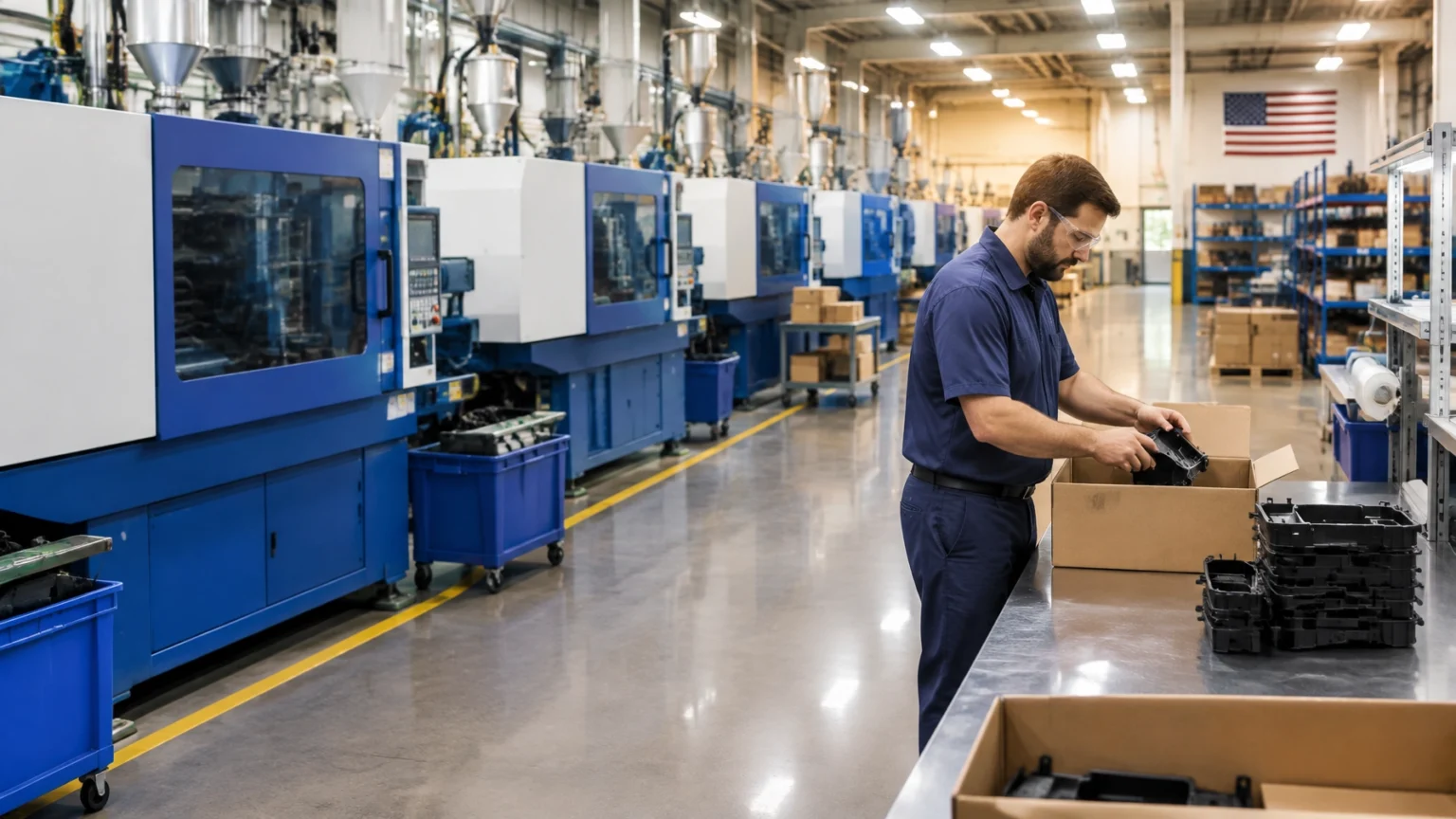
Short-run injection molding can help a business move from prototype to production without ordering more parts than it can use. But small quantities do not mean small manufacturing requirements. Tooling decisions, resin control, process repeatability, and clear ownership terms matter whether the order is a few hundred pieces or several thousand.
The right partner treats a short run as a legitimate production project, not an interruption between larger jobs. Use this 10-point checklist to assess a potential supplier.
What does short-run injection molding mean?
There is no universal volume threshold for a short run. Depending on part design, tool construction, resin, number of cavities, and supplier, the term may describe anything from dozens of parts to several thousand. As rough planning ranges, a pilot build might involve hundreds of parts, while low-volume production can extend into the thousands. These are guidelines, not fixed industry definitions.
Short runs commonly support:
- Pilot builds for customer feedback, functional testing, or assembly trials
- Bridge production while production tooling is being completed or demand is being confirmed
- Niche products with limited or irregular demand
- Low-volume production parts for specialized equipment, replacement needs, or smaller markets
A 3D-printed prototype can help assess form and fit, but molded parts made from the intended resin can better represent production behavior. For an overview of the process, see Delaney’s guide to
injection molding.
The 10-point short-run molder checklist
1. Confirm mold ownership and transferability
Establish who owns the mold and what that ownership includes. Spell out the tool’s identity and components, such as mold base, inserts, hot-runner equipment, and any dedicated fixtures. Clarify who can authorize modifications, where the mold will be kept, and how it can be released or transferred if your supplier changes.
Ask for the transfer process in writing. It should explain how the mold will be identified, prepared, and delivered, and who is responsible for related costs. A mold described as customer-owned is not fully protected if the contract does not explain how you can retrieve it.
2. Ask whether there is a minimum order quantity
A low-volume supplier should explain what it can produce, not assume every customer needs a large production order. Ask about minimums for the molding run, resin purchase, colorant, packaging, and any assembly operations. These requirements can differ, so clarify whether a quoted quantity is a firm minimum or a cost-effective recommendation.
A no-minimum policy can be especially useful for pilot builds, niche products, or staged releases. The quote should still clearly show how setup and production costs affect per-part pricing at different quantities.
3. Get a clear mold maintenance and storage plan
A mold needs care between runs as well as during production. Ask how the supplier handles cleaning, lubrication, corrosion prevention, and checks of components such as vents, cooling channels, ejectors, and slides. The appropriate maintenance schedule depends on the tool and its operating conditions; it should not be based on an arbitrary cycle count.
If the tool will be stored between orders, confirm the storage conditions and how its status is recorded. Request a maintenance log noting the tool identity, work performed, repairs, and any known issues. Agree in advance on which services are included and which require approval.
4. Require material and colorant documentation
Identify the resin by
manufacturer and grade, rather than relying on a broad description such as “ABS or equivalent.” Resin changes can affect strength, flexibility, shrinkage, appearance, and processing requirements. Document the approved colorant or masterbatch, color target, and any required material characteristics, such as UV or flame performance.
Also agree on how material substitutions, regrind, and lot traceability will be handled. If color or material consistency is important to your product, specify how samples will be reviewed and approved. Delaney’s
plastic materials overview can help orient early material discussions.
5. Check who handles tooling and mold management
Short-run work still requires practical tooling support. Ask whether the supplier can review an existing mold, coordinate new tooling, manage mold changes, and support sampling. If toolmaking is performed by another company, find out who is responsible for communication, schedules, design updates, and resolving issues.
Ask what deliverables you will receive for a new tool. Depending on the project, these may include tool drawings, a component list, sample history, and an agreed record of approved changes. A clear point of responsibility helps prevent handoffs from becoming schedule gaps.
6. Look for DFM and prototyping support before the tool is built
A good partner reviews how the part will be molded before tooling is released. Design for manufacturability (DFM) feedback should address factors such as wall thickness, draft, ribs and bosses, undercuts, parting line, gate location, ejection, and likely shrinkage or warpage.
These details affect both tool design and part performance. A gate may leave a mark on a cosmetic surface; insufficient draft can make a part difficult to eject; thick sections can increase the risk of sink or uneven cooling. Ask the supplier to identify concerns and document any agreed design changes.
Prototypes can help validate the design before investment in a production mold. For a new product, Delaney offers
CAD design, prototyping, and development support.

7. Find out whether assembly and fulfillment are available
The molded part may be only one step before a product is ready to ship. Ask whether the supplier can handle assembly, finishing, packaging, labeling, and delivery to your warehouse or customers. Keeping these operations coordinated under one roof can reduce handoffs and make it easier to troubleshoot quality or packaging issues.
Be specific about the finished deliverable: loose parts, kits, assembled units, retail-ready packaging, or individual shipments. Include packaging requirements and quantities in the quote so that the production plan reflects the work beyond molding.

8. Evaluate communication and response expectations
A short-run project often has active decisions around samples, design feedback, material selection, and delivery timing. Ask who will be your point of contact and how quickly the supplier typically responds to project questions. Confirm how you will receive updates when a schedule or technical issue changes.
Responsiveness is not a substitute for manufacturing capability, but it is part of managing the work. Clear communication helps teams make timely decisions and avoid preventable delays.
9. Consider the value of domestic production
Domestic production can make it easier to communicate across similar time zones, visit the facility, review parts, or coordinate a tool transfer. It may also reduce some transportation complexity. However, location alone does not guarantee quality or a reliable schedule.
Ask where the parts will actually be molded and what operations, if any, are subcontracted. Compare total project cost, lead time, shipping, and communication needs, not just the quoted price per part.
10. Verify process fit and production quality
Confirm that the supplier can run your part and resin within the required process and quality expectations. The molding machine must be a suitable fit for the tool, including requirements such as clamp force and shot size. Ask how the supplier will inspect the part, record approvals, and address defects or process changes.
Provide a current drawing and CAD revision, define critical dimensions and cosmetic requirements, and identify which characteristics require inspection. For repeat orders, ask how approved material and process information will be retained. These controls support consistency from one short run to the next.
What separates a short-run specialist from a molder that merely accepts small jobs?
A supplier may agree to a small order but still plan and price it like a large production run. A genuine short-run partner discusses the project at its actual scale. They are prepared to talk through order quantities, tooling, resin availability, sampling, maintenance between runs, and how the design could change as demand develops.
Look for practical answers, not just assurances. A capable partner should be able to explain what is included in a quote, how a mold will be managed, what information is needed to assess a part, and how the team will handle a repeat order. A detailed conversation about your requirements is often more useful than a low unit price that leaves key responsibilities unclear.
Choose a partner for the whole production path
Short-run injection molding is most effective when the project has a clear plan for both the parts and the tooling. Before selecting a supplier, share the part drawing or CAD file, resin requirements, expected order quantities, quality criteria, packaging needs, and any target dates. Ask for a proposal that separates tooling, sampling, production, and any assembly or fulfillment work.
Delaney Manufacturing Services supports projects from product development and prototyping through plastic injection molding, mold management, and fulfillment. With more than 50 years of experience, no minimums or maximums, and production in Bradenton, Florida, the team works with both new product concepts and existing molds. To discuss a project,
submit your specifications for a quote.
|
| Images for illustrative purposes. |