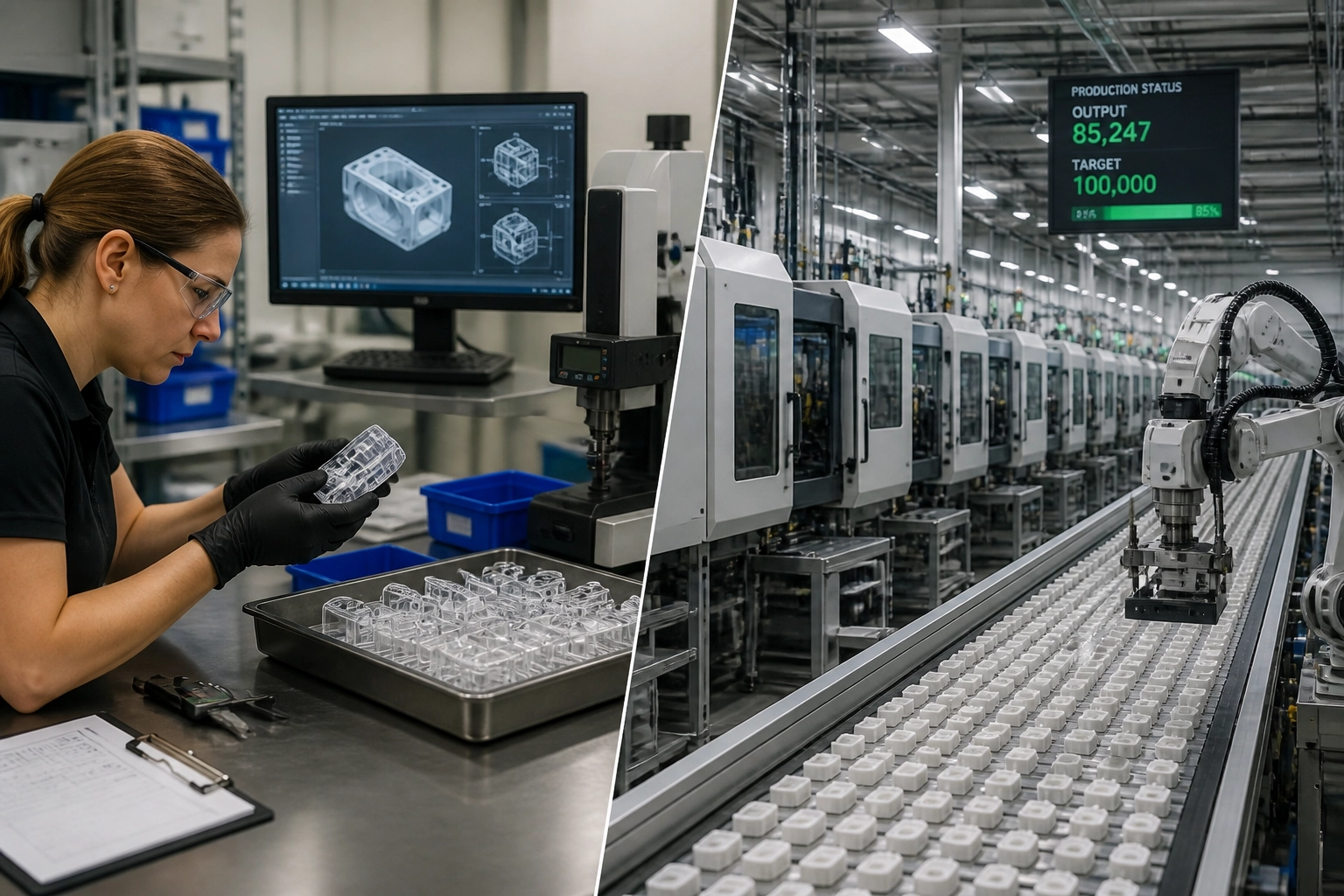
For inventors, entrepreneurs, and established product managers alike, the transition from a conceptual design to a physical product is one of the most critical phases of development.
Central to this transition is a pivotal manufacturing decision:
short-run injection molding versus
high-volume injection molding.
Choosing the wrong path can lead to significant financial risk. Overinvesting in high-volume tooling before a product is market-validated can result in thousands of units of dead inventory. Conversely, relying solely on low-volume methods when demand spikes can lead to missed opportunities and inflated per-unit costs.
At
Delaney Manufacturing Services, we have spent over 50 years guiding clients through this exact crossroad. This article provides a comprehensive technical and strategic comparison to help you determine which approach aligns with your current product lifecycle stage.
Defining the Technical Landscape
To understand which method is right for your launch, you must first understand the fundamental differences in tooling, material science, and investment requirements.
Short-Run Injection Molding
Short-run injection molding typically refers to production quantities ranging from a few dozen to 10,000 units. The hallmark of this approach is the use of “soft” tooling: often made from high-grade aluminum or P20 bridge steel. These materials are easier and faster to machine than the hardened steels used in mass production.
- Lead Times: Generally 2 to 4 weeks.
- Tooling Investment: Significantly lower upfront cost.
- Flexibility: Easier and less expensive to modify the mold if design tweaks are needed after the first batch.
High-Volume Injection Molding
High-volume injection molding is designed for production runs of 75,000 to millions of parts. This requires “hard” tooling made from hardened tool steel (such as H13), which is engineered to withstand the heat and pressure of hundreds of thousands of cycles without degrading.
- Lead Times: Generally 8 to 12 weeks for mold creation.
- Tooling Investment: High upfront capital requirement.
- Efficiency: Lowest possible per-unit cost once production is underway.
The Strategic Advantage of Short-Run Molding for Product Launches
For a new product launch,
short-run injection molding is often the superior strategic choice. The primary goal of a launch is not just to sell, but to
validate.
1. Risk Mitigation and “No Minimums”
One of the most significant barriers to entry for inventors is the “Minimum Order Quantity” (MOQ) imposed by many large-scale manufacturers. At Delaney, we maintain a
no minimum policy. This allows you to produce a pilot run of 500 units to test market demand without the financial burden of a 50,000-unit commitment.
2. Design Agility
Even the most refined
CAD designs can face unexpected feedback once the product is in the hands of real users. With short-run aluminum tooling, making minor adjustments to the mold is a relatively straightforward process. If you invest in a $50,000 multi-cavity steel mold and then discover a design flaw, the cost of correction can be devastating.
3. Faster Time-to-Market
In competitive industries, the first-mover advantage is real. Because short-run molds can be produced in a fraction of the time, you can have a “retail-ready” product in fulfillment centers while your competitors are still waiting for their high-volume molds to be shipped from overseas.
 Our integrated facility allows for rapid inspection and assembly, bridging the gap between prototyping and full-scale production.
When to Transition to High-Volume Production
High-volume molding is the “end game” for successful products. Once your product-market fit is proven and your order volume becomes predictable, the transition to high-volume manufacturing becomes a matter of fiscal efficiency.
Achieving Economies of Scale
In injection molding, the cost per unit is heavily influenced by the speed of the cycle and the number of “cavities” in the mold. High-volume molds often feature 8, 16, or even 32 cavities, meaning every time the machine cycles, it produces 32 parts simultaneously. This drastically reduces the labor and overhead costs allocated to each part.
Material Consistency and Durability
High-volume molds are built for longevity. If your product requires highly abrasive materials (such as glass-filled resins), a soft aluminum mold will wear out quickly. Hardened steel tooling ensures that part number 1,000,000 is identical to part number one.
 Automation and precision are the keys to maintaining quality in high-volume medical and consumer electronics production.
The Delaney Advantage: Seamless Scaling Under One Roof
One of the greatest challenges in manufacturing is “vendor hop”: using one shop for prototyping, another for short runs, and a third for mass production. This often leads to communication breakdowns, lost tooling, and inconsistent quality.
Delaney Manufacturing Services eliminates this friction by offering a comprehensive, end-to-end solution:
- Product Development: We help you take a napkin sketch to a finished CAD model and 3D-printed prototype.
- In-House Mold Management: Whether we are building a new mold or managing your existing tooling, our experts ensure optimal performance.
- Secondary Services: Beyond molding, we offer UV Inkjet Printing, laser etching, and ultrasonic welding to provide a truly finished product.
- Fulfillment and Drop-Shipping: We don’t just make the parts; we assemble, package, and ship them directly to your customers or distributors.
 Our in-house UV inkjet and laser marking capabilities allow for professional branding at both low and high volumes.
Decision Matrix: Which One Should You Choose?
| Goal |
Choose Short-Run If… |
Choose High-Volume If… |
| Budget |
Initial capital is limited. |
You have secured funding for scale. |
| Market Data |
You are testing a new concept. |
Demand is proven and consistent. |
| Speed |
You need parts within 4 weeks. |
You can afford an 8–12 week lead time. |
| Complexity |
The design may still change. |
The design is locked and finalized. |
| Volume |
You need < 10,000 parts. |
You need > 50,000 parts. |
Conclusion
The choice between short-run and high-volume injection molding is not a one-time decision, but a journey. For most product launches, starting with
short-run molding provides the necessary safety net to test, refine, and grow. As your brand gains traction, the move to
high-volume production provides the margins necessary for long-term profitability.
With over five decades of expertise,
Delaney Manufacturing Services specializes in helping you navigate this entire lifecycle. From your first 100 units to your first million, we provide the technical guidance and manufacturing precision to ensure your product succeeds in the marketplace.
Ready to bring your product to life? Contact us today for a same-day response and a comprehensive quote on your next project.
|
| Images for illustrative purposes. |