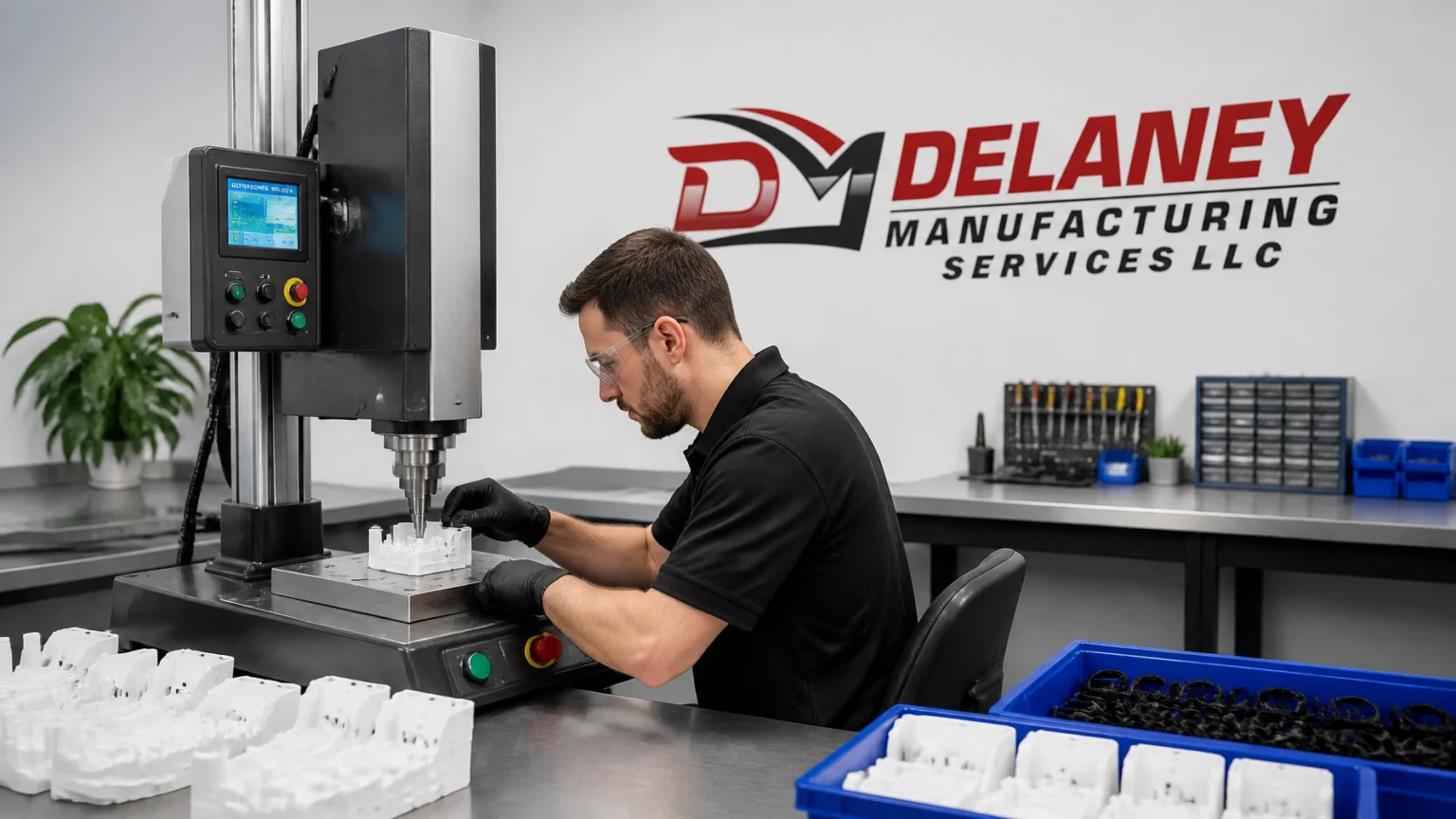
In the competitive landscape of modern manufacturing, the integrity of a product is only as strong as its weakest joint. Whether engineering a rugged automotive housing, a life-saving medical diagnostic tool, or a consumer electronics casing, manufacturers face a constant challenge: how to bond thermoplastic components securely, rapidly, and cost-effectively without introducing chemical contaminants, heavy mechanical fasteners, or messy adhesives.
While traditional methods like solvent bonding, epoxies, and screw bosses have their place, they often introduce processing bottlenecks, added weight, and long curing times. Enter
ultrasonic welding: an advanced, high-frequency assembly technology that has revolutionized how thermoplastic parts are joined. By harnessing acoustic energy to create molecular-level bonds, ultrasonic welding delivers unmatched speed, cleanliness, and structural strength.
1. The Physics and Working Principles of Ultrasonic Welding
At its core, ultrasonic welding is a solid-state joining process that uses high-frequency mechanical vibrations to unite thermoplastic parts. Operating typically at frequencies between
15 kHz and 40 kHz, the system converts electrical line power into high-frequency mechanical motion.
The process sequence relies on three primary mechanical components:
- The Converter (Transducer): Transforms electrical energy into mechanical vibrations using piezoelectric crystals.
- The Booster: Amplifies or attenuates the amplitude of the vibrations transmitted from the converter.
- The Sonotrode (Horn): A precision-tuned metal tool: typically crafted from titanium or hardened aluminum: that applies the acoustic vibrations directly to the workpiece.
When the horn descends onto the clamped plastic parts, high-frequency vibrations are delivered to the joint interface. Because thermoplastics possess poor thermal conductivity, friction and rapid molecular shearing generate localized heat instantaneously at the contact points. Within milliseconds, a thin, uniform molten layer forms. Once the vibration cycle ceases, clamping pressure is maintained briefly as the material cools and solidifies under load, creating a homogenous structural weld whose tensile strength frequently matches or exceeds that of the parent material.

2. Key Engineering Benefits Over Traditional Joining Methods
Engineers and product designers increasingly specify ultrasonic welding because it addresses the primary limitations of mechanical and chemical fastening. The advantages span production efficiency, structural performance, and environmental compliance:
- Ultra-Fast Cycle Times: Weld cycles are typically completed in under two seconds. This rapid solidification allows for high-throughput, automated production lines that keep per-unit costs remarkably low.
- Elimination of Consumables: By fusing the plastic directly, the process completely eliminates the need for screws, rivets, glues, and chemical solvents. This reduces bill-of-materials costs and simplifies inventory management.
- Exceptional Joint Strength: Properly optimized welds create molecular bonds that distribute stress evenly across the joint area, avoiding the stress concentrations typical of threaded fasteners.
- Clean, Contaminant-Free Assembly: Because no solvents or adhesives are used, there is no outgassing, curing time, or risk of chemical residue contaminating sensitive internal components.
- Minimal Thermal Impact: Heat generation is strictly localized to the joint interface. Surrounding walls and delicate interior geometry remain unaffected by thermal distortion.
3. Critical Design Considerations: Joint Geometry and Energy Directors
Achieving a flawless ultrasonic weld requires careful attention during the
custom plastic part design phase. Unlike metals, which can be welded with raw flat surfaces, plastics require specialized joint configurations to guide the melt flow and concentrate acoustic energy effectively.
The most common design feature is the
energy director: a small, triangular or bead-shaped ridge molded onto one of the mating surfaces. When the ultrasonic horn applies pressure and vibration, the energy director acts as the initial point of contact, absorbing the acoustic energy and melting rapidly to fill the joint interface.
Other essential design strategies include:
- Shear Joints: Ideal for crystalline plastics and hermetic seals, where mating parts telescope into one another and weld along a vertical interface under continuous friction.
- Step Joints: Provide precise alignment and an aesthetic outer flash trap, ensuring clean exterior parting lines.
- Energy Control Hulls: Designed to prevent relative part shifting during the high-acceleration vibration phase.

4. Industry Applications: From Automotive to Medical Devices
The versatility and reliability of ultrasonic welding have made it an indispensable technique across diverse industrial sectors:
Automotive Components
Modern vehicles rely on lightweight plastics to improve fuel efficiency and electric vehicle range. Ultrasonic welding is widely used for instrument clusters, interior door panels, under-hood fluid reservoirs, and exterior lighting housings where vibration resistance and hermetic seals are mandatory.
Medical Devices and Diagnostics
In healthcare manufacturing, cleanliness and absolute reliability are non-negotiable. Disposable medical devices: such as blood filters, intravenous (IV) flow components, surgical suction canisters, and diagnostic cartridges: frequently utilize ultrasonic welding. The process is particulate-free and fully compatible with stringent cleanroom standards.
Consumer Electronics and Appliances
From handheld sensor housings to waterproof wearable tech and kitchen appliance enclosures, manufacturers depend on ultrasonics to protect delicate circuit boards and internal sensors from moisture, dust, and mechanical shock.
5. Integrating Advanced Assembly Under One Roof
Successfully implementing ultrasonic welding into a production lifecycle requires more than just high-end machinery; it demands seamless coordination between mold design, material selection, parameter tuning, and post-molding secondary operations.

At Delaney Manufacturing Services, we eliminate the friction of working with multiple disjointed vendors. By combining advanced
plastic injection molding services with comprehensive
post-molding assembly capabilities, we take projects from concept through to retail-ready fulfillment entirely under one roof. Our engineering team collaborates with clients at every stage: optimizing joint geometries, selecting the ideal thermoplastic resins, and calibrating ultrasonic welding parameters to ensure maximum bond integrity.
Whether you are scaling up production for a high-volume consumer product or developing a specialized precision enclosure, our experienced team provides responsive communication, rigorous quality control, and dependable manufacturing partnerships tailored to your exact project scope.
|
| Images for illustrative purposes. |