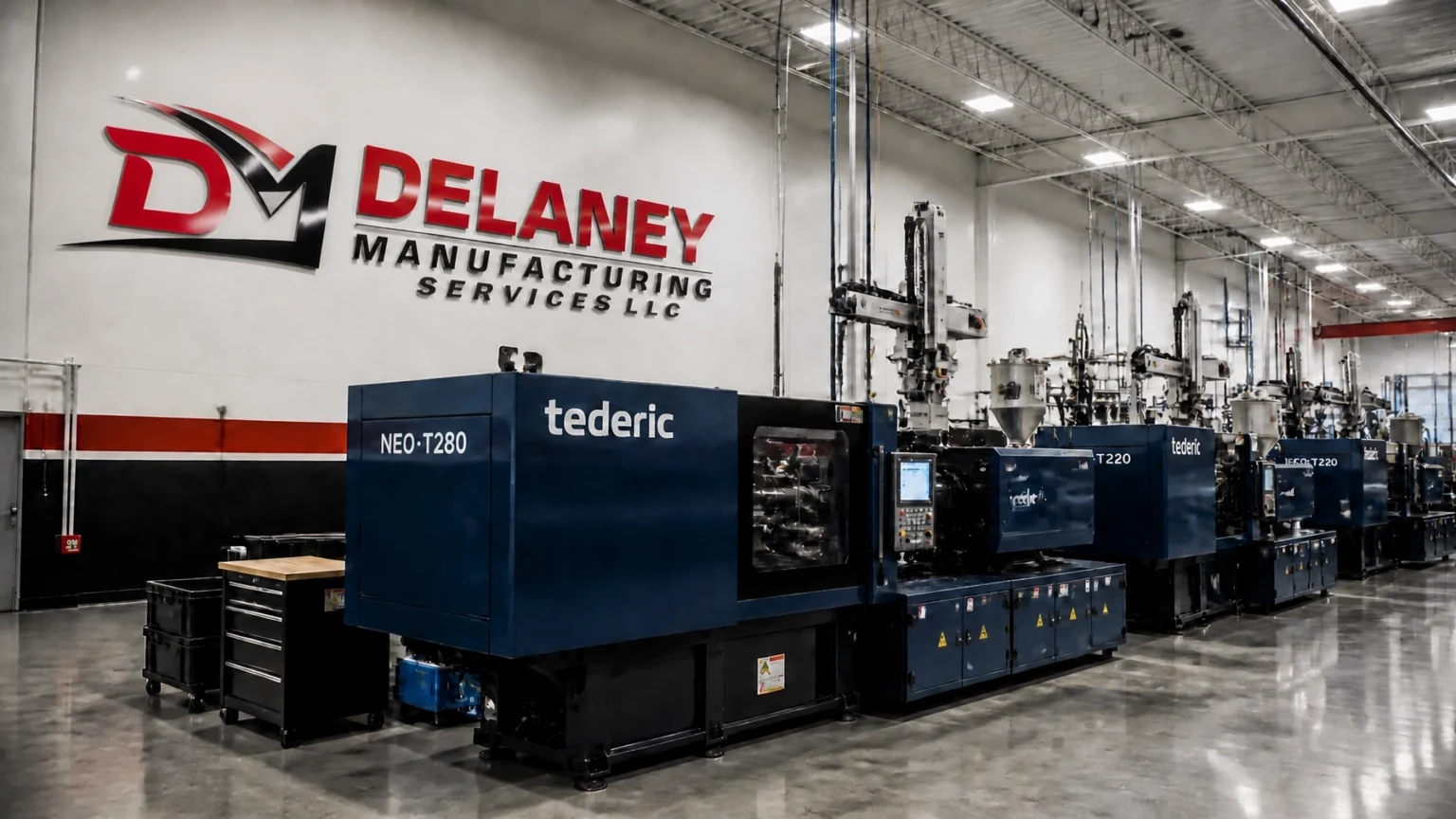
In the landscape of modern product development, the demand for components that offer more than just basic structural integrity is rapidly increasing. Engineers and product developers are moving beyond single-material designs to embrace multi-material solutions that enhance functionality, aesthetics, and performance.
Two of the most effective techniques for achieving these results are
overmolding and
insert molding. While they are often grouped together as multi-shot processes, they involve distinct technical mechanisms and offer different strategic advantages. At
Delaney Manufacturing Services, we utilize these advanced techniques to help our clients consolidate parts, reduce assembly costs, and create superior products.
Understanding Insert Molding: The Functional Core
Insert molding is a manufacturing process where a pre-formed component: the “insert”: is placed into the mold cavity before the plastic resin is injected. Once the mold closes, the molten plastic flows around the insert, encapsulating it and creating a single, integrated part.
The Technical Process
- Insert Placement: The insert, which is most commonly metal (brass, steel, or stainless) but can also be ceramic, a magnet, or electronic circuitry, is placed into the mold manually or via automation.
- Injection: The mold is closed, and the thermoplastic resin is injected.
- Encapsulation: The plastic shrinks slightly as it cools, creating a powerful mechanical lock around the features of the insert, such as knurls, grooves, or undercuts.
Common Applications
Insert molding is the industry standard for adding
metal threads to plastic housings, ensuring that screws can be tightened and loosened repeatedly without stripping the material. It is also essential for manufacturing electrical connectors, sensors, and automotive fasteners where high structural strength is required.

Defining Overmolding: The Art of Layering
Overmolding is the process of molding a second layer of plastic or elastomer over a previously molded part, known as the
substrate. This is typically a “plastic-on-plastic” or “rubber-on-plastic” combination.
The Technical Process
- Substrate Molding: The base part (the substrate) is molded first using a rigid thermoplastic like ABS, Polycarbonate, or Nylon.
- The Second Shot: The substrate is then placed into a second mold (or the tool rotates in a multi-shot machine), and a second material: often a soft Thermoplastic Elastomer (TPE) or Thermoplastic Polyurethane (TPU): is injected over specific areas of the base.
- The Bond: The two materials bond through a combination of chemical adhesion and mechanical interlocking.
Common Applications
You see overmolding in every industry, from the
soft-touch grips on power tools and surgical instruments to the waterproof seals on consumer electronics. It is primarily used to improve ergonomics, provide vibration dampening, or add a premium aesthetic finish.

Technical Comparison: Overmolding vs. Insert Molding
| Feature |
Insert Molding |
Overmolding |
| Substrate Type |
Pre-formed (usually metal, ceramic, or electronics) |
Molded plastic part (the first shot) |
| Bonding Type |
Primarily mechanical (shrinking around the insert) |
Chemical adhesion and mechanical interlock |
| Primary Goal |
Functional strength, metal threads, or conductivity |
Ergonomics, sealing, and aesthetic differentiation |
| Tooling Complexity |
Lower (single-shot tooling with insert nests) |
Higher (multi-shot or transfer tooling) |
| Material Types |
Metal + Plastic |
Plastic + Plastic or Plastic + TPE/Rubber |
Strategic Benefits for B2B Product Development
Implementing these techniques during the
new product development phase offers several competitive advantages for manufacturers.
1. Part Consolidation and Cost Savings
One of the most significant benefits is the elimination of secondary assembly steps. Instead of molding multiple parts and later fastening, gluing, or welding them together, insert molding and overmolding create a finished assembly in a single cycle. This reduces labor costs, simplifies your supply chain, and minimizes the risk of assembly errors.
2. Enhanced Durability and Reliability
Multi-material molding creates a permanent bond that cannot be achieved with adhesives or mechanical fasteners. In
insert molding, the metal component is locked into the plastic structure, providing superior resistance to vibration and environmental stress. In
overmolding, the outer layer can act as a shock-absorbing shield or a hermetic seal, protecting internal components from moisture and dust.
3. Improved User Interface and Ergonomics
For products that require human interaction, overmolding provides a “soft-touch” feel that reduces user fatigue and improves grip. This is critical for medical devices, hand tools, and industrial equipment where safety and comfort are paramount.
4. Metal-to-Plastic Conversion
Many manufacturers are looking to reduce weight and cost by
converting metal parts to plastic. Insert molding allows for this transition by maintaining metal strength in critical areas (like bolt holes) while utilizing lightweight, high-performance plastics for the rest of the component.
Design for Manufacturability (DFM) Considerations
Successful multi-material molding requires precise engineering. When designing for
plastic injection molding services, several factors must be considered:
- Material Compatibility: Not all plastics bond together. For overmolding, the substrate and the overmold material must be chemically compatible to achieve a cohesive bond.
- Wall Thickness: Maintaining uniform wall thickness is vital to prevent sink marks and ensure proper flow of the second material shot.
- Mechanical Interlocks: To ensure the overmold never peels away, engineers should design undercuts, holes, or ribs in the substrate to provide a “lock.”
- Shut-off Design: The mold must be designed to “shut off” against the substrate or the insert to prevent “flash”: where molten plastic leaks into areas it shouldn’t be.
Why Choose Delaney Manufacturing Services?
At Delaney Manufacturing Services, we bring over
50 years of experience to every project. We understand that whether you are an entrepreneur with a new concept or an established manufacturer, you need a partner who can navigate the complexities of multi-material molding.
Our
integrated process takes you from a “napkin sketch” to a retail-ready product. We provide comprehensive CAD design, 3D printing for rapid prototyping, and full-scale injection molding production.
We pride ourselves on our:
- End-to-End Solutions: Everything from mold production to assembly and fulfillment happens under one roof.
- No Minimums: We work with you regardless of project size, supporting both short-run and high-volume needs.
- Same-Day Responses: We value your time and ensure rapid communication to keep your project on schedule.
Conclusion
Overmolding and insert molding are transformative processes that allow for the creation of smarter, more durable, and more ergonomic products. By choosing the right technique and the right manufacturing partner, you can significantly reduce costs while improving the quality of your finished goods.
Ready to explore how multi-material molding can elevate your next project?
Delaney Manufacturing Services is here to guide you through the technical design and production stages.
|
| Images for illustrative purposes. |