For decades, the standard playbook for B2B procurement managers, inventors, and consumer goods companies was simple: outsource high-volume plastic component manufacturing to Asia to achieve the lowest possible piece price. However, the global manufacturing landscape has shifted dramatically. With evolving tariff policies in 2026, fluctuating freight rates, and heightened supply chain vulnerabilities, evaluating the true cost of production requires looking far beyond the initial factory-gate quote.
When analyzing
plastic injection molding services, procurement teams must calculate the
total landed cost rather than relying on FOB (Free on Board) pricing alone. In this analysis, we examine how 2026 tariffs, shipping overhead, tooling investments, and quality control risks impact the bottom line when comparing US domestic manufacturing with traditional offshore regions like China, as well as nearshore alternatives like Mexico and Vietnam.
1. The 2026 Tariff Snapshot: Molds vs. Production Parts
Tariff structures in 2026 have fundamentally altered the economics of international sourcing. To understand the true financial impact, procurement professionals must separate the costs associated with
tooling (molds) from the ongoing costs of
molded production parts.
Injection Molds (Tooling)
- US Domestic: 0% tariffs. Purchasing tools from a domestic manufacturer eliminates import duties, customs brokerage fees, and international shipping friction entirely.
- China: Subject to Section 301 tariffs (typically 25%), base MFN duties (3–4%), and additional executive surcharges implemented through 2025–2026. The combined effective duty rate on many mold HTS codes (such as HTS 8480.71) frequently reaches 40% to 50% of the declared customs value.
- Mexico (USMCA): 0% Section 301 tariffs and zero additional duties for qualifying goods under the United States-Mexico-Canada Agreement.
- Vietnam & China+1 Regions: 0% Section 301 tariffs, with standard MFN duties typically ranging between 0% and 3.4%, avoiding punitive punitive surcharges.
Molded Plastic Parts (Production Components)
- US Domestic: 0% tariffs with complete price stability and predictable local freight.
- China: Section 301 tariffs on plastic goods remain steep, typically ranging between 7.5% and 25%, with certain specialized classifications facing stacked duties up to 50%. These tariffs apply to every individual shipment based on its customs value.
- Mexico & Vietnam: Generally 0% additional tariffs on qualifying manufactured components under current trade frameworks, preserving much of their cost-competitiveness.
2. Tooling Economics: FOB Price vs. Landed Cost

When sourcing a new mold, overseas suppliers often present extremely attractive FOB quotes. A mid-complexity multi-cavity production mold that might cost
$20,000 to $40,000 in a US shop can often be quoted out of China for
$12,000 to $25,000.
However, factoring in 2026 duties changes the equation significantly:
- The Landed Tool Cost: Adding a 40–50% cumulative tariff, ocean freight, international marine insurance, and customs brokerage to a Chinese mold often pushes its landed cost into the $18,500 to $38,500 range. For small-to-medium tools, China can still maintain a modest up-front price advantage, but the gap narrows considerably.
- Iteration and Engineering Changes: Overseas tooling introduces substantial risk when design modifications are required. Remitting a mold back and forth across international borders for engineering changes results in prohibitive shipping expenses, weeks of production downtime, and severe communication overhead due to time zone disparities.
- Tool Ownership and IP Risk: Domestic tool procurement ensures strict adherence to US intellectual property standards and provides direct, physical access to your molds throughout their operational lifecycle.
3. Production Part Economics: Why Tariffs Change the Math
While tooling is a one-time capital expense, production parts represent recurring costs incurred with every single purchase order. This is where tariff structures exert the most severe pressure on offshore budgets.
Recent comparative studies evaluating high-volume molded components produced in Guangdong (China), Bajío (Mexico), and Florida (US) illustrate how the total landed cost breaks down on a per-unit basis:
| Cost Component (Per Unit) |
China |
Mexico |
US Domestic |
| Molded Unit Piece Price |
$1.42 |
$1.48 |
$1.65 |
| International / Local Freight |
$0.38 |
$0.06 |
$0.02 |
| Tariffs & Duties |
$0.78 |
$0.00 |
$0.00 |
| Inventory Carrying Cost |
$0.24 |
$0.04 |
$0.01 |
| Total Landed Cost |
$2.97 |
$1.63 |
$1.68 |
Key Takeaways from the Data:
- The Factory Gate Illusion: While China boasts the lowest initial piece price ($1.42 vs. US $1.65), stacked tariffs and international freight inflate the final landed cost to nearly $2.97 per unit.
- The Nearshore Advantage: Mexico emerges as a highly competitive nearshore alternative, offering low freight and zero tariffs under USMCA.
- The Domestic Value Proposition: US domestic production, once viewed as cost-prohibitive, is frequently more economical than China on a total landed cost basis when accounting for zero tariffs, minimal freight, and significantly reduced inventory carrying costs.
4. Operational Friction: Lead Times, Quality Control, and Communication
Beyond raw financial accounting, B2B buyers must evaluate the operational hidden costs associated with geographic distance.
- Lead Times and Supply Chain Resilience: Offshore supply chains require weeks of ocean transit, port handling, and customs clearance. Disruptions at major shipping hubs can paralyze assembly lines. Domestic manufacturing offers agile scheduling, rapid turnaround, and responsive delivery schedules.
- Quality Assurance and Defect Remediation: Discovering a dimensional defect in a container load shipped from overseas creates catastrophic project delays. Addressing quality control issues locally allows engineering teams to inspect production floors directly and implement immediate corrective actions.
- Communication Overhead: Managing overseas suppliers often involves overnight email cycles, language barriers, and limited visibility into active production runs. Partnering with a responsive domestic facility ensures real-time collaboration and rapid communication.
5. The Strategic Case for US Domestic Manufacturing

For businesses seeking stability, predictability, and uncompromising quality, domestic reshoring has transitioned from a strategic trend into an essential risk-mitigation strategy.
Partnering with an experienced American manufacturer like
Delaney Manufacturing Services eliminates tariff volatility entirely. With over 50 years of industry expertise, Delaney provides comprehensive, end-to-end capabilities housed entirely under one roof. Our integrated service model supports clients across every stage of the product lifecycle:
- Product Development & Prototyping: Transitioning concepts from initial CAD design and rapid 3D printing to functional prototypes and retail-ready products. Learn more about our approach in our comprehensive guide to plastic injection molding.
- Precision Injection Molding: High-quality manufacturing for both short-run batches and high-volume production with flexible minimums. Explore our capabilities on our plastic injection molding services page.
- Mold Production & Management: Expert handling of existing tooling or custom manufacturing of new molds tailored to exact engineering specifications.
- Metal-to-Plastic Conversion: Re-engineering heavy metal components into durable, lightweight, high-performance plastic parts to reduce material and shipping weight. Read more in our guide to metal-to-plastic conversion.
- Full-Service Assembly & Fulfillment: In-house secondary operations: including ultrasonic welding, custom packaging, and direct drop-shipping: streamline supply chains and reduce administrative overhead.
Conclusion: Making the Right Sourcing Decision in 2026
When evaluating
plastic injection molding services in 2026, procurement managers must look beyond the initial quotation spreadsheet. While offshore suppliers may occasionally offer lower upfront tooling prices, the accumulation of Section 301 tariffs, ocean freight surcharges, extended lead times, and inventory carrying costs frequently makes international sourcing more expensive in the long run.
By partnering with an established domestic manufacturer that offers same-day responses, end-to-end project management, and uncompromising quality control, businesses can safeguard their profit margins, protect their intellectual property, and ensure seamless supply chain execution.
To evaluate how domestic manufacturing can optimize your next product launch or production run,
contact Delaney Manufacturing Services today to connect with our engineering team.
|
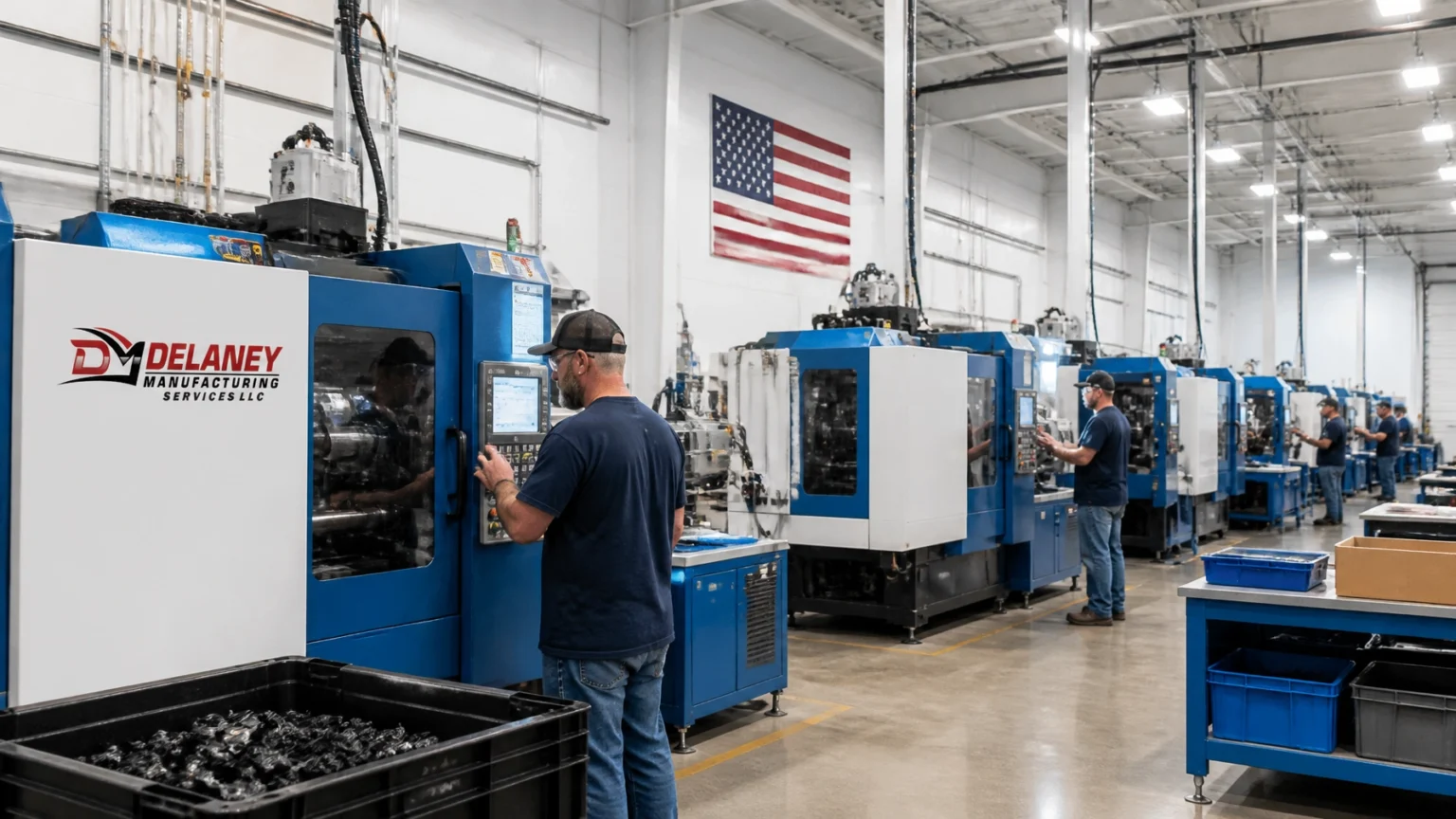
| Images for illustrative purposes. |