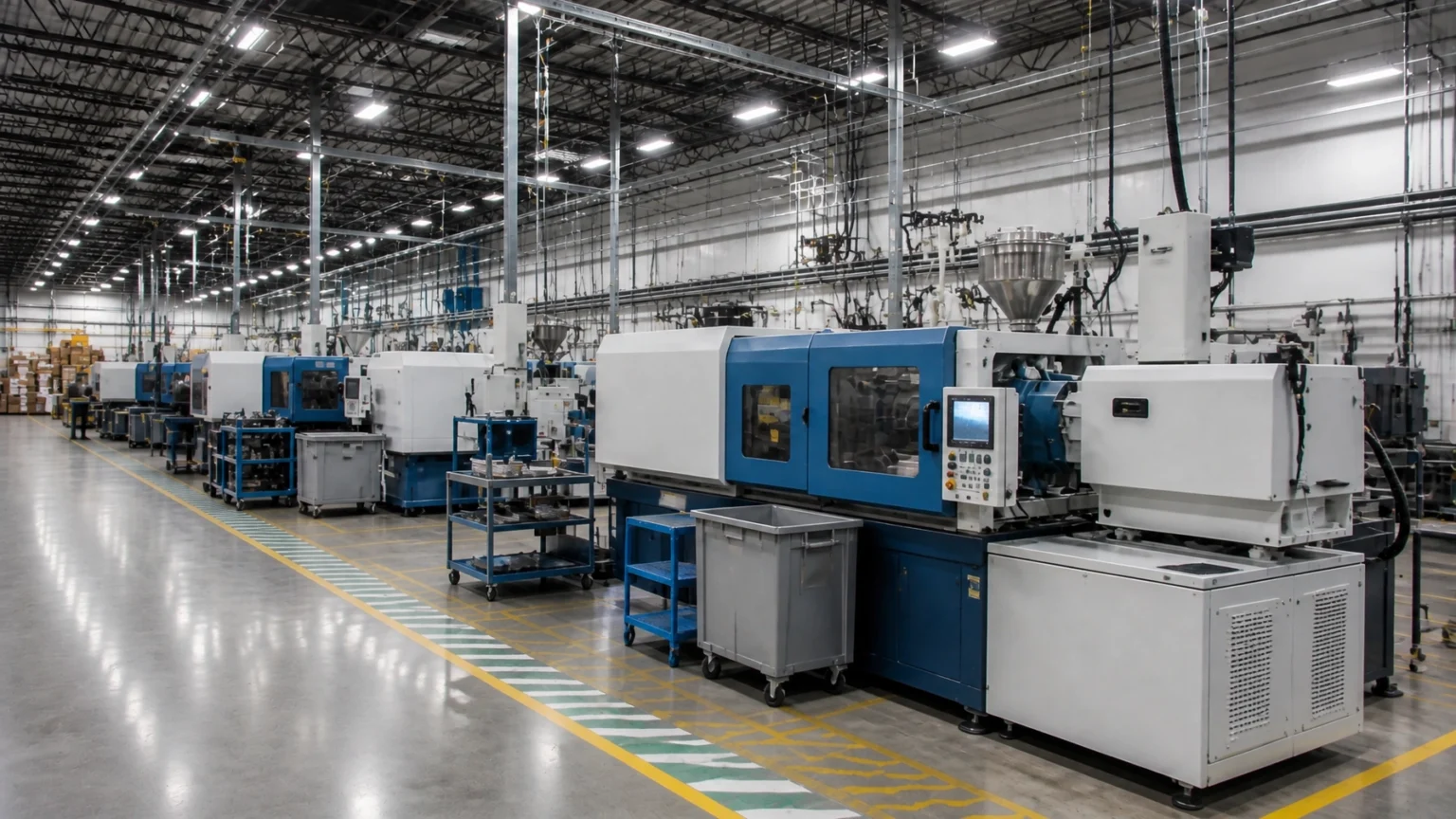
Custom injection molding is the standard manufacturing process for producing high-quality, repeatable plastic components at scale. While the technology behind it involves complex thermodynamics and mechanical engineering, the core business concept is straightforward: creating a dedicated metal tool (a mold) to produce identical parts with extreme precision.
For businesses moving from a prototype to a retail-ready product, understanding this process is vital. At
Delaney Manufacturing Services, we leverage over 50 years of industry experience to guide clients through every stage, from a napkin sketch to final fulfillment.
This guide provides a comprehensive overview of the custom injection molding lifecycle, designed to be read in under three minutes for a high-level summary, with detailed insights for those ready to dive deeper.
The Core Concept: How It Works
At its most basic level, injection molding involves melting plastic resin and forcing it under high pressure into a custom-machined metal cavity. Once the plastic cools and solidifies, the mold opens, the part is ejected, and the process repeats.
The efficiency of this process lies in its
repeatability. Once the mold is perfected, the cost per unit drops significantly, making it the most economical choice for medium-to-high-volume production.
Phase 1: Product Development and DFM
The success of a molded part is determined long before the first pellet of plastic is melted. It begins with
Product Development.
Many entrepreneurs and manufacturers approach us with a concept or a basic 3D model. Our role is to perform
Design for Manufacturability (DFM) analysis. This stage ensures that the part can be produced efficiently without defects. Key considerations during DFM include:
- Draft Angles: Tapering the walls of the part to ensure it releases easily from the mold.
- Wall Thickness: Maintaining consistent thickness to prevent warping or sink marks.
- Gate Placement: Identifying where the molten plastic will enter the mold to minimize visible marks.
- Radii and Fillets: Rounding sharp corners to improve material flow and part strength.
We often utilize
3D printing and rapid prototyping during this phase to validate the design before committing to expensive metal tooling.

Phase 2: Mold Production and Tooling
The mold (or “tool”) is the most significant upfront investment in the process. It is a high-precision instrument machined from steel or aluminum using
CNC milling and
Electrical Discharge Machining (EDM).
Tooling Materials
- Steel Molds: These are the industry standard for high-volume production. Steel is incredibly durable and can produce millions of parts over its lifetime.
- Aluminum Molds: Often used for short-run production or prototyping. They are faster to machine and cost less than steel but have a shorter lifespan.
Cavity Configuration
A mold can be designed as a
single-cavity tool (one part per cycle) or a
multi-cavity tool (multiple identical parts per cycle). Increasing the number of cavities increases the initial tooling cost but significantly lowers the per-part price during production because the machine output is multiplied.
Phase 3: Material Selection
Choosing the right plastic resin is critical to the part’s performance. Custom injection molding allows for a vast array of materials, each with unique properties:
- ABS (Acrylonitrile Butadiene Styrene): Known for impact resistance and toughness; commonly used for electronic enclosures.
- Polypropylene (PP): Flexible and resistant to chemicals; ideal for living hinges and containers.
- Polycarbonate (PC): Transparent and extremely strong; used for medical components and safety lenses.
- Nylon (PA): High strength and wear resistance; often used in mechanical gears or automotive parts.
At
Delaney Manufacturing Services, we also specialize in
Metal-to-Plastic Conversion. By re-engineering heavy metal components into durable, high-performance plastics, we help clients reduce weight and manufacturing costs without sacrificing structural integrity.
Phase 4: The Injection Molding Cycle
Once the mold is installed in the injection molding machine, the production cycle follows a specific, automated sequence:
- Clamping: The two halves of the mold are clamped together with enough force to resist the pressure of the injected plastic.
- Injection: The machine’s screw pushes molten plastic from the heated barrel into the mold cavity.
- Packing/Holding: Pressure is maintained to ensure the cavity is completely filled and to account for material shrinkage as it cools.
- Cooling: This is typically the longest stage of the cycle. Water channels inside the mold help dissipate heat, solidifying the plastic.
- Ejection: The mold opens, and ejector pins push the finished part out.

Phase 5: Secondary Operations and Fulfillment
For many manufacturers, the process ends when the part drops out of the machine. At Delaney, we view injection molding as just one step in the product lifecycle. Most retail-ready products require
Secondary Operations to be truly finished.
Our in-house capabilities include:
- Assembly: Combining multiple molded parts or integrating hardware.
- Custom Branding: Using UV inkjet printing or laser etching to add logos, scales, or instructions directly to the plastic.
- Packaging: Preparing products for retail, including bagging, boxing, and labeling.
- Fulfillment: We offer direct drop-shipping, managing your inventory and shipping directly to your end customers.

Why Choose Delaney Manufacturing Services?
Navigating the complexities of custom injection molding requires a partner who understands both the technical and business sides of manufacturing.
We distinguish ourselves through a “value-first” approach:
- No Minimum Order Quantities (MOQs): We work with you whether you need a short run of 500 parts or a high-volume run of 500,000.
- End-to-End Solutions: We handle everything from the initial CAD design to the final drop-shipment, reducing the need for multiple vendors.
- Speed and Communication: We pride ourselves on same-day responses and transparent project management.
- 50+ Years of Experience: Our longevity in the industry means we have solved nearly every molding challenge imaginable.
Whether you are looking to convert a metal part to plastic or need a partner to bring a new invention to market, our team is ready to assist.
Get Started Today
If you have a design ready for review or simply a concept on a napkin,
contact Delaney Manufacturing Services to discuss your project. We provide expert guidance to ensure your custom injection molding project is a success from the very first shot.
|
| Images for illustrative purposes. |